Natural-Looking Face & Neck Lift Surgery and Personalized Anti-Aging Care in Apgujeong, Gangnam, Seoul
4.1 ★ Google · Board-Certified Plastic Surgeon
en-US

Abdominal Liposuction · Consultation Required
Abdominal Liposuction
Abdominal liposuction removes fat cells from beneath the skin of the abdomen using a thin cannula inserted through small incisions, permanently reducing fat volume in the treated area rather than producing general weight loss.
Schedule a Consultation
Abdominal Liposuction

Reviewer Details
Medically reviewed by Dr. Choi deokho, Representative Director & Plastic Surgeon, Good-Line Plastic Surgery Clinic.
Registered as the clinic's legal representative in the Korean National Tax Service registry, Full Member of the Korean Society of Plastic and Reconstructive Surgeons · Last reviewed 2026-08-18 · Good-Line Plastic Surgery Clinic, Gangnam-gu, Seoul.
Abdominal liposuction is a surgical procedure that removes localized excess fat from the abdomen through small incisions and a cannula, refining abdominal contour without the larger scars or extended recovery associated with open surgery. At Good-Line Plastic Surgery Clinic in Seoul, it is performed by Dr. Choi deokho as one of the principal procedures offered through the clinic's dedicated Body Line Center, and it is the clinic's most requested surgical body-contouring treatment.
What Is Abdominal Liposuction?
Abdominal liposuction removes fat cells from beneath the skin of the abdomen using a thin cannula inserted through small incisions, permanently reducing fat volume in the treated area rather than producing general weight loss.
Uses tumescent fluid infused into the treatment area before fat removal, which helps loosen fat, reduce bleeding, and improve patient comfort during suctioning.
A small cannula is passed beneath the skin through limited incisions to loosen and suction fat in a controlled, layered pattern across the abdomen.
Performed under local anesthesia with sedation for more limited procedures, or general anesthesia when the treatment area is larger or combined with other procedures.
Targets localized abdominal fat that has not responded to diet and exercise, rather than treating loose skin, stretch marks, or cellulite directly.
Permanently reduces the number of fat cells in the treated abdominal area, though any remaining fat cells can still enlarge with significant future weight gain.
Is intended as a contouring treatment to improve abdominal shape and proportion, not a weight-loss procedure for patients carrying significant excess body weight overall.
Who Performs Abdominal Liposuction at Good-Line Plastic Surgery Clinic

Dr. Choi deokho
Representative Director and plastic surgeon
Dr. Choi deokho is the Representative Director and plastic surgeon at Good-Line Plastic Surgery Clinic, with approximately 25 years associated with the clinic since its founding in 2001. While his stated core specializations center on facial plastic surgery — including eye surgery, rhinoplasty, facial contouring, and anti-aging and lifting — he is also the clinic's sole listed surgeon overseeing body-contouring procedures at its dedicated Body Line Center, including abdominal liposuction. He holds full membership in the Korean Society of Plastic and Reconstructive Surgeons, the Korean Society for Microsurgery, the Korean Cleft Palate-Craniofacial Association, the Japan Society of Aesthetic Plastic Surgery, the American Society of Aesthetic Plastic Surgery, and the International Society of Aesthetic Plastic Surgery.
Before recommending abdominal liposuction, Dr. Choi reviews each patient's medical history, medications, allergies, previous surgery, lifestyle, and aesthetic goals, and personally examines the abdomen to assess the amount and distribution of fat, skin quality, and overall body contour. Photographs are commonly taken as part of this assessment, and the surgeon then determines whether liposuction alone is appropriate or whether a different or combined approach would serve the patient better.
Because a patient requesting "abdominal liposuction" may, on examination, actually have loose skin as the dominant concern rather than excess fat — a distinction liposuction alone cannot correct — this physical evaluation is treated as a central part of the consultation rather than a formality before booking a standard procedure. Dr. Choi's evaluation process places real weight on matching each patient's actual anatomy, rather than their initial request, to the surgical plan most likely to hold up over time.
Abdominal Liposuction Options Available
Abdominal liposuction at Good-Line Plastic Surgery Clinic follows a tumescent, cannula-based technique: small incisions, tumescent fluid infusion to loosen fat and reduce bleeding, and controlled suctioning of fat beneath the skin. The clinic references a proprietary "Fix the Line" liposuction approach among its stated differentiators, though clinic-specific technical detail on this branded technique is not confirmed publicly and should be discussed directly with the surgeon. Publicly available information also does not establish whether the clinic's abdominal procedure additionally uses a specific energy-based technology, such as ultrasound-assisted or laser-assisted liposuction, alongside the standard cannula-based method — this should likewise be confirmed at consultation rather than assumed by the patient in advance.
What is grounded and consistently described is that the extent of the planned procedure — a smaller, more focal area of fat versus a larger or combined treatment plan — meaningfully changes the anesthesia approach, duration, and aftercare required, as summarized in the comparison below.
Focal Abdominal Liposuction | Larger-Volume or Combined Abdominal Liposuction |
|---|---|
Addresses a smaller, more contained area of localized abdominal fat | Addresses a larger fat volume, multiple abdominal zones, or is combined with another procedure (for example, Y-Zone liposuction and lift) in the same session |
Commonly performed under local anesthesia with sedation | Often performed under general anesthesia given the larger treatment scope or combined procedures |
Typically completed toward the shorter end of the one-to-three-hour range | Typically takes longer within the one-to-three-hour range, and may require longer observation or overnight care |
Recovery generally follows the standard timeline below without added complexity | May involve a somewhat longer initial recovery given the larger treatment area or an added procedure |
Choosing between a more limited, focal treatment and a larger or combined plan is not a matter of patient preference alone — it depends on the actual volume and distribution of fat found on examination, the patient's skin elasticity, and their overall health. This is why the consultation and physical examination, rather than a fixed treatment menu, determines the final surgical plan recommended to each patient.
Who Is a Good Candidate for Abdominal Liposuction?
Adults who are generally healthy, close to their stable or desired weight, with localized excess abdominal fat that has not responded well to diet and exercise.
Patients with reasonably good skin elasticity and abdominal muscle tone, since liposuction addresses fat rather than loose or lax skin.
Patients with realistic expectations who understand abdominal liposuction is intended to improve shape and proportion, not to serve as a general weight-loss method.
Generally healthy individuals without uncontrolled medical conditions, significant bleeding or clotting problems, or active infection.
Patients able and committed to maintaining a stable weight afterward, since liposuction results are best preserved without significant future weight gain.
Not suitable candidates generally include those seeking significant overall weight loss, those whose primary concern is loose abdominal skin rather than excess fat, pregnant patients, and those with unstable weight or medical conditions that make anesthesia or surgery unsafe.
A medical evaluation with the surgeon is required before any surgical body-contouring treatment, including abdominal liposuction, to confirm individual candidacy.
What to Expect: Procedure, Recovery, and Results Timeline
Abdominal liposuction generally begins with marking the treatment area, followed by appropriate anesthesia — local anesthesia with sedation for more limited procedures, or general anesthesia for larger or combined cases. Small incisions are made, a cannula is inserted beneath the skin, and fat is loosened and suctioned out in a controlled manner before the incisions are closed and a compression garment is applied. The procedure typically takes about one to three hours, depending on the amount of fat removed, the area treated, and whether other procedures are performed in the same session; larger procedures may require longer observation or overnight care.
Timepoint | What typically happens |
|---|---|
Day 0 | Local anesthesia with sedation, or general anesthesia for larger/combined procedures; small incisions, cannula-based fat removal, compression garment applied before discharge or overnight observation |
Day 1-3 | Pain, swelling, and bruising are most noticeable; activity is significantly restricted; the compression garment is worn continuously as instructed |
Day 5-10 | Many patients feel substantially better; an initial postoperative check is commonly scheduled within this window before international patients consider traveling home |
Week 4-8 | Swelling continues to improve; abdominal contour becomes progressively clearer as fluid retention resolves; the compression garment is typically still worn per the surgeon's guidance |
Month 12+ | Final contour has fully settled; results are best maintained through a stable body weight over the long term |
Before surgery, patients are generally asked to disclose their complete medical history, current medications, supplements, allergies, and any previous procedures. Medications and supplements that increase bleeding risk — such as aspirin, certain anti-inflammatory drugs, and some herbal supplements — may need to be adjusted or stopped in advance only on the surgeon's instructions, and smoking or vaping is generally discouraged given its effect on healing. Patients should arrange transportation home and, ideally, assistance during the first night, since sedation or anesthesia is commonly used.
Aftercare commonly includes following the surgeon's wound-care and medication instructions, wearing the compression garment as directed, avoiding strenuous activity initially, and attending scheduled follow-up appointments. Some fluid drainage and temporary numbness around the treated abdomen are common early on and generally resolve with healing. Liposuction permanently reduces fat cell count in the treated area, but substantial weight gain afterward can still change the overall abdominal contour — a stable weight is the main factor supporting a lasting result over time.
International patients evaluating abdominal liposuction in Seoul commonly weigh how long they need to remain in Korea before flying home. As a practical estimate, a stay of approximately five to seven days is often suggested so an initial postoperative check can be completed before departure, though the exact duration depends on the procedure, any combined treatments, and individual healing — this should be confirmed directly with the clinic rather than assumed from a general guideline. Good-Line Plastic Surgery Clinic offers an English-language contact channel for international patients considering abdominal liposuction.
Combining Abdominal Liposuction with Other Treatments
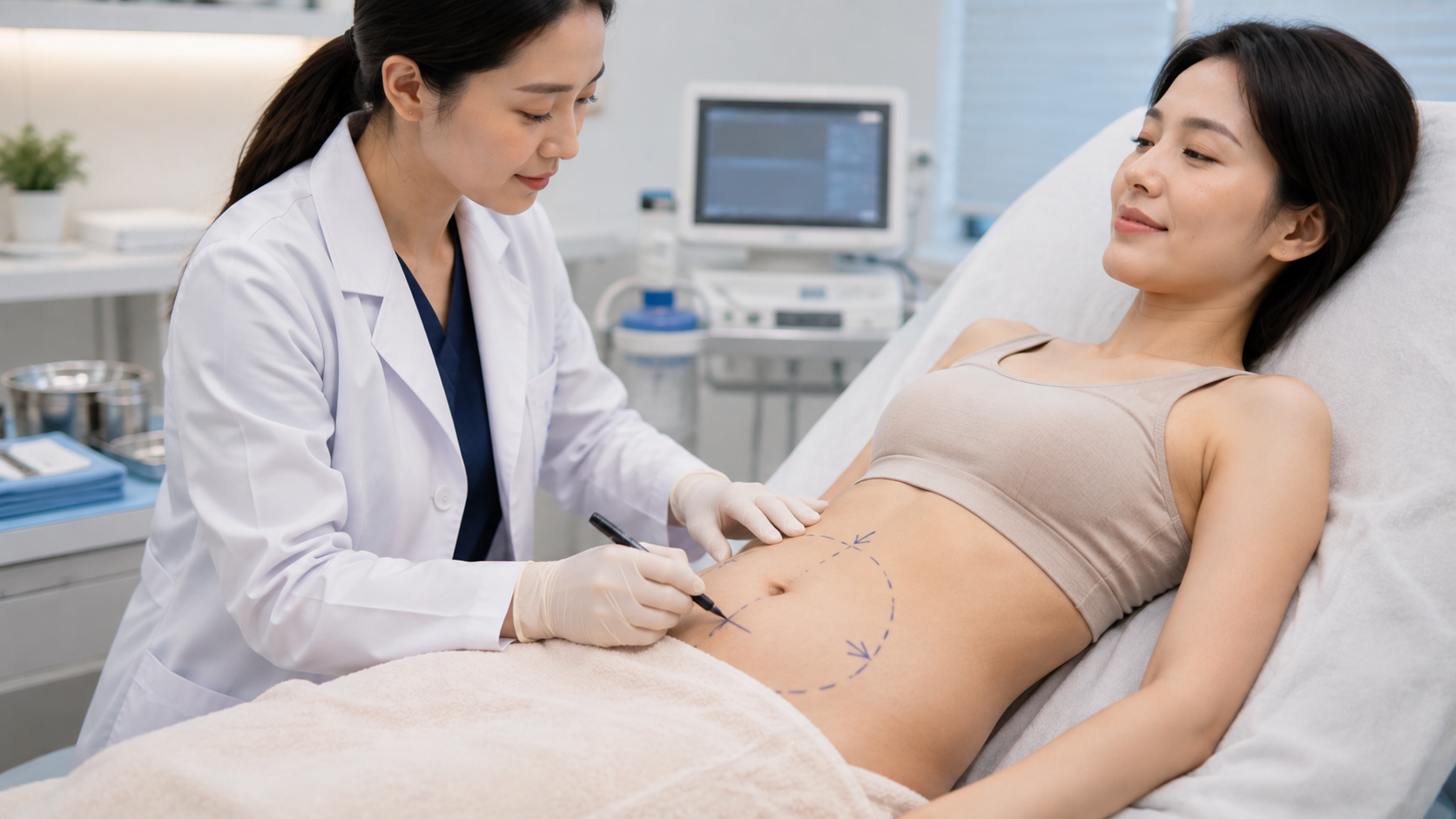
Abdominal liposuction can be performed alone or combined with other body-contouring or plastic-surgery procedures when clinically appropriate for the patient.
A tummy tuck (abdominoplasty) may be considered instead of, or together with, abdominal liposuction when significant excess abdominal skin or muscle separation is present — liposuction alone addresses fat, while a tummy tuck also removes excess skin and can include muscle repair.
Y-Zone Liposuction & Lift is sometimes combined with abdominal liposuction in the same surgical session for patients whose fat distribution spans both the abdomen and the lower torso/inner-thigh region, subject to an individual assessment of total anesthesia time and recovery capacity.
Non-surgical body-shaping sessions may be used to maintain or refine results in smaller areas following surgical abdominal liposuction, or as a starting option for patients who are not yet ready for surgery.
Patients whose goals extend beyond the abdomen to breast shape or proportion may also discuss breast augmentation, breast lift, or breast reduction during the same consultation, since these fall under the clinic's broader Body Line Center alongside liposuction procedures.
Combining procedures within a single surgical session can reduce total recovery time compared with staging treatments across separate visits, which matters particularly for international patients planning travel around a limited window of time. At the same time, combining multiple procedures extends total anesthesia time and can lengthen recovery, so the surgical team weighs the specific combination against the patient's overall health and each procedure's individual healing requirements before recommending whether to combine or stage treatments.
Safety, Precision, and Clinic Standards
Good-Line Plastic Surgery Clinic is a Registered Medical Institution for Attracting Foreign Patients, certified by Korea's Ministry of Health and Welfare under the Medical Overseas Expansion and Foreign Patients Attraction Act. Dr. Choi deokho is a full member of the Korean Society of Plastic and Reconstructive Surgeons. Patients are assessed individually for fat distribution, skin elasticity, weight stability, and medical history before an abdominal liposuction plan is finalized. As with any liposuction procedure, temporary swelling, bruising, soreness, numbness, and contour irregularities are possible. Rare but serious complications — including infection, fluid accumulation, bleeding, blood clots, and anesthesia-related complications, particularly with more extensive procedures — should be reviewed individually with the surgeon before proceeding (see ASPS — Liposuction Safety). Sterile surgical technique, individualized fat-removal planning, and careful candidate selection are treated as baseline requirements at the clinic rather than differentiators. Postoperative risk reduction depends as much on scheduled follow-up monitoring as on the surgery itself, since a missed follow-up visit can delay identification of a complication that is generally straightforward to manage when caught early. Patients are encouraged to contact the clinic promptly about any concerning symptom — unusual pain, fever, spreading redness, or unexpected swelling — rather than waiting for the next scheduled appointment.
The Bottom Line
Abdominal liposuction removes localized abdominal fat through small incisions and a cannula, refining contour rather than producing general weight loss.
It does not address loose abdominal skin, muscle separation, or cellulite — these concerns are generally better managed with a tummy tuck or a combined surgical approach.
The extent of the planned procedure — focal versus larger-volume or combined — determines the anesthesia approach, duration, and recovery expectations for each patient.
Reviewed and performed under Dr. Choi deokho, a board-registered, experienced plastic surgeon with roughly 25 years at the clinic.
Final abdominal contour becomes clearer over weeks to months and is best maintained through a stable weight after surgery.
Frequently Asked Questions
How is abdominal liposuction performed? The treatment area is marked, anesthesia is administered based on the extent of the procedure, small incisions are made, and a cannula is used with tumescent technique to loosen and suction fat from beneath the skin before incisions are closed and a compression garment is applied.
Is abdominal liposuction painful during recovery? Anesthesia controls pain during the procedure itself. Afterward, soreness, swelling, bruising, and tightness around the abdomen are common in the first days and generally improve gradually, with pain medication available if prescribed.
Will abdominal liposuction remove my stretch marks or loose skin? No. Abdominal liposuction is designed to remove localized fat, not to tighten loose skin or eliminate stretch marks. Patients whose primary concern is loose skin are generally better served by a tummy tuck or a combined surgical approach discussed at consultation.
How much fat can be removed in one abdominal liposuction session? The amount depends on each patient's individual fat distribution, overall health, and the surgeon's assessment of a safe volume for a single session; this is determined during consultation rather than by a fixed standard amount applied to every patient.
How soon can I return to work after abdominal liposuction? Many patients feel substantially better within the first one to two weeks, though the exact timing depends on job demands and how strenuous the role is, as well as individual healing and whether other procedures were combined with the liposuction.
Do I need to wear a compression garment, and for how long? Yes — a compression garment is applied after surgery and is generally worn continuously in the early recovery period, then per the surgeon's guidance as swelling improves over the following weeks; the exact duration is confirmed individually with the surgical team.
Can abdominal liposuction be combined with a tummy tuck or Y-Zone liposuction in the same visit? In appropriate cases, yes. Whether combining procedures is advisable depends on total anesthesia time, the patient's overall health, and individual recovery capacity, and is assessed during consultation rather than offered as a standard package to every patient.
How many days should I plan to stay in Korea for abdominal liposuction? Approximately five to seven days is often a practical planning estimate, allowing an initial postoperative check before flying home, though the exact duration depends on the specific procedure and individual recovery — confirm this directly with the clinic.
Book a Consultation at Good-Line Plastic Surgery Clinic
To discuss whether abdominal liposuction, a combined surgical approach, or a different body-contouring option best fits your goals, contact Good-Line Plastic Surgery Clinic in Gangnam-gu, Seoul at +82 2 543 1830 or through the clinic's online contact form. A consultation with the surgeon is the only reliable way to determine which approach fits your specific fat distribution, skin quality, and aesthetic goals.
Disclaimer
This page is for general informational purposes and does not constitute individualized medical advice. Candidacy, technique, and expected outcomes can only be determined through a consultation with a qualified physician.
Sources & Further Reading
Other Services
Explore additional treatments offered by our specialists.

Under-Eye Fat Repositioning
Under-eye fat repositioning is a transconjunctival lower-eyelid procedure that redistributes — rather than discards — the fat compartments beneath the eye, moving them around the orbital bone to correct hollowing and bulging caused by aging skeletal and.
Learn More

TRIPLE CELL
TRIPLE CELL is a non-invasive, radiofrequency-based skin treatment designed to deliver energy into different layers of the skin to support hydration, elasticity, and collagen-related skin recovery.
Learn More

Thermage Skin Tightening
Thermage Skin Tightening is a non-surgical radiofrequency treatment that heats targeted tissue beneath the skin to stimulate collagen remodeling, improving the appearance of mild-to-moderate skin laxity.
Learn More