Natural-Looking Face & Neck Lift Surgery and Personalized Anti-Aging Care in Apgujeong, Gangnam, Seoul
4.1 ★ Google · Board-Certified Plastic Surgeon
en-US

Abdominal Liposuction · Consultation Required
Breast Augmentation
Breast augmentation is a surgical procedure that increases breast size and improves breast shape and proportion by placing an implant beneath breast tissue or the chest muscle, or in select cases by transferring a patient's own fat into the breast.
Schedule a Consultation
Breast Augmentation

Reviewer Details
Medically reviewed by Dr. Choi deokho, Representative Director & Plastic Surgeon, Good-Line Plastic Surgery Clinic.
Registered as the clinic's legal representative in the Korean National Tax Service registry, Full Member of the Korean Society of Plastic and Reconstructive Surgeons · Last reviewed 2026-08-18 · Good-Line Plastic Surgery Clinic, Gangnam-gu, Seoul.
Breast augmentation is a breast surgery that increases breast volume and reshapes breast contour using an implant or, in select cases, a patient's own transferred fat, and it is one of several breast-focused procedures offered within Good-Line Plastic Surgery Clinic's Body Line Center in Seoul. At Good-Line Plastic Surgery Clinic, the procedure is built around cohesive gel implants, endoscopic visualization during tissue dissection, and the clinic's patented implant-insertion apparatus, each intended to support a more controlled, smaller-incision approach to placing the implant.
What Is Breast Augmentation?
Breast augmentation is a surgical procedure that increases breast size and improves breast shape and proportion by placing an implant beneath breast tissue or the chest muscle, or in select cases by transferring a patient's own fat into the breast.
Uses cohesive gel (silicone) implants selected according to the patient's height, bust size, chest shape, breast dimensions, degree of sagging, body composition, and desired outcome.
Performed at Good-Line Plastic Surgery Clinic using an endoscopic, direct-visualization technique that allows the surgeon to identify tissue layers and control bleeding during dissection.
Places the implant through an incision shortened with the clinic's patented insertion apparatus, which the clinic states can insert a cohesive gel implant through an opening approximately 60% the length of a conventional incision, in about five seconds.
Performed under sedation anesthesia with local anesthetics and hydrodissection according to the clinic's stated protocol, an approach the clinic associates with reduced tissue injury and bleeding; the exact anesthesia plan for a given case is confirmed with the surgeon.
Typically takes approximately one to two hours, depending on implant type, technique, and whether any other procedure is combined in the same session.
Who Performs Breast Augmentation at Good-Line Plastic Surgery Clinic
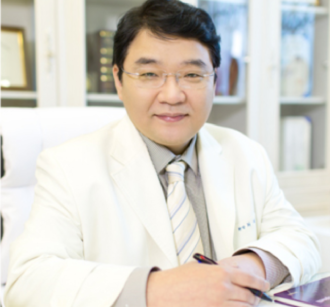
Dr. Choi deokho
Representative Director and plastic surgeon
Dr. Choi deokho is the Representative Director and plastic surgeon at Good-Line Plastic Surgery Clinic, with approximately 25 years associated with the clinic since its establishment in 2001. While his stated core specializations center on facial plastic surgery — including eye surgery, rhinoplasty, facial contouring, and anti-aging and lifting — he also oversees the breast-focused procedures performed within the clinic's Body Line Center as the clinic's sole listed surgeon, including breast augmentation, breast lift after childbirth, and breast reduction. He holds full membership in the Korean Society of Plastic and Reconstructive Surgeons, the Korean Society for Microsurgery, the Korean Cleft Palate-Craniofacial Association, the Japan Society of Aesthetic Plastic Surgery, the American Society of Aesthetic Plastic Surgery, and the International Society of Aesthetic Plastic Surgery. Before recommending breast augmentation, he reviews the patient's height, bust size, chest shape, breast length and shape, degree of sagging, body composition, age, weight, and childbirth history, together with blood testing and X-ray testing, and discusses the patient's preferences before an implant size and technique are selected.
Because a request for "breast augmentation" can describe very different underlying goals — restoring volume lost after childbirth, correcting asymmetry, or simply increasing overall breast size for a patient who has never been pregnant — the consultation places real weight on identifying which concern is actually driving the request before recommending an implant size or technique. A patient whose primary concern is post-childbirth volume loss combined with breast sagging may be a better candidate for augmentation combined with a lift, discussed further below, than for augmentation alone, since an implant does not reliably correct significant sagging on its own. This distinction between volume loss and position loss is treated as a central part of the surgical planning process, not a formality before booking a standard implant size.
Breast Augmentation Options Available
Good-Line Plastic Surgery Clinic's material describes two primary approaches to increasing breast volume, most often selected based on the patient's own tissue, prior childbirth history, and desired outcome.
Implant-Based Augmentation | Autologous Fat Transfer Augmentation |
|---|---|
Places a cohesive gel (silicone) implant beneath breast tissue or chest muscle via an endoscopic technique and the clinic's patented insertion apparatus | Transfers the patient's own fat, harvested by liposuction from another area, into the breast to add volume |
Best for patients wanting a more significant, predictable increase in breast size, including those with underdeveloped breasts | Best for patients seeking a modest, natural-feeling volume increase using their own tissue, often after childbirth or weight loss |
Performed under sedation anesthesia with local anesthetics and hydrodissection per the clinic's stated protocol; commonly takes about 1-2 hours | Requires a donor-site liposuction step in addition to fat processing and injection; total procedure time depends on the volume and areas involved |
Implant-based augmentation is the clinic's primary approach for patients seeking a defined, larger volume increase, using cohesive gel implants selected for the patient's chest dimensions and desired result. Autologous fat transplantation is presented as an alternative specifically for patients rebuilding volume after childbirth or weight loss, where a smaller, tissue-based increase using the patient's own fat may be preferred over an implant. For patients whose primary concern is significant breast sagging rather than lost volume, the clinic states that breast lifting is the more relevant procedure, and that augmentation and lifting can be performed together when lifting alone would not achieve a satisfactory result — this combination is discussed further below. Which approach — implant, fat transfer, or a combined augmentation-lift procedure — is appropriate depends on the surgeon's physical examination of breast tissue, skin elasticity, and existing volume, rather than the patient's initial preference alone.
Who Is a Good Candidate for Breast Augmentation?
Adults with fully developed breasts, underdeveloped or small breast size, or reduced breast volume after childbirth or weight loss, who want increased breast volume and improved body proportion.
Patients with realistic expectations about outcome, understanding that implant size is selected based on height, bust size, chest shape, breast dimensions, degree of sagging, and body composition rather than a single standard size.
Patients with breast asymmetry seeking correction as part of the same procedure.
Patients considering autologous fat transfer specifically, who have adequate donor fat available and are seeking a more modest, tissue-based volume increase rather than a larger implant-based result.
Generally healthy adults without untreated breast disease, active infection, or uncontrolled medical conditions that would make elective surgery unsafe.
Not suitable candidates generally include pregnant or breastfeeding patients, and those with significant uncontrolled medical conditions, active infections, or unrealistic expectations — final suitability requires medical evaluation, blood testing, and X-ray testing before surgery.
What to Expect: Procedure, Recovery, and Results Timeline
Breast augmentation at Good-Line Plastic Surgery Clinic generally follows a consistent sequence: the surgeon assesses breast shape, size, chest proportions, and degree of sagging; the patient and surgeon discuss the desired breast size and select an appropriate implant; the surgical area is prepared and anesthesia administered; the surgical space is created while the surgeon views the tissue through an endoscope; bleeding is controlled during tissue dissection; the cohesive gel implant is inserted using the clinic's patented insertion apparatus; and the incision is closed with a postoperative dressing and pressure support applied. The procedure generally takes approximately one to two hours, depending on implant type, technique, and whether any additional procedure is combined in the same session.
Stage | What typically happens |
|---|---|
Day 0 (day of surgery) | Sedation anesthesia with local anesthetics and hydrodissection per clinic protocol; endoscopic implant placement; a blood drainage pocket and pressure bandage are applied |
Day 1-3 | Follow-up visit the day after surgery; some pain, swelling, and tightness are most noticeable, generally decreasing significantly within 3-4 days |
Day 5-10 | Functional supportive underwear typically begins around day 2-3; additional outpatient visits continue until stitches are removed around day 7-9; discomfort is usually minimal by about one week |
Week 4-8 | Irritation nearly disappears by around two weeks; many patients resume a broader range of normal activity by around six weeks, with strenuous exercise and heavy lifting still restricted for several weeks |
Month 12+ | The surgical area may take approximately 6 months to 1 year to fully settle, with breasts looking and feeling more natural as swelling fully resolves |
Before surgery, patients are generally asked to avoid scheduling the procedure during menstruation when possible, to treat any significant cold or ache beforehand, and to stop smoking and alcohol approximately one to two weeks in advance. Medications and supplements that can affect bleeding or recovery — including aspirin, vitamin E, and certain traditional or herbal medicines — should be discussed with the surgeon in advance, and blood testing and X-ray testing are recommended before surgery; patients are also asked to fast for more than eight hours when general anesthesia is used. Patients should arrange transportation home and assistance during the initial recovery period, since sedation or anesthesia is used.
Aftercare commonly includes use of a blood drainage pocket to prevent blood accumulation, a pressure bandage to reduce swelling and help stabilize the implant, and functional supportive underwear worn from approximately two to three days after surgery. Follow-up is recommended the day after surgery, with approximately two to three additional outpatient visits until stitches are removed around seven to nine days post-surgery. Patients are advised to avoid excessive pressure on the breasts, alcohol, smoking, and strenuous exercise during early recovery. International patients evaluating breast augmentation in Seoul should confirm the appropriate length of stay and the earliest safe date to fly home directly with the clinic, since this depends on individual healing and whether any procedure is combined; Good-Line Plastic Surgery Clinic offers an English-language contact channel for international patients.
Combining Breast Augmentation with Other Treatments

Breast augmentation and breast lifting can be performed together when a lift alone would be unlikely to provide a satisfactory result, most relevant for patients whose primary concern includes significant sagging alongside volume loss.
Autologous fat transfer augmentation requires a donor-site liposuction step; patients considering this approach may discuss whether their donor-site needs overlap with a broader body-contouring goal, such as Abdominal Liposuction, during the same consultation.
Patients whose primary concern is nipple or areola appearance may also raise nipple surgery, inverted nipple surgery, or areola reduction during the same consultation, since these fall under the clinic's broader Body Line Center alongside breast augmentation.
Combining procedures within a single surgical session can reduce total recovery time compared with staging treatments across separate visits, which matters for international patients planning travel around a limited window of time, though combining multiple procedures also extends anesthesia time and can lengthen recovery — the surgical team weighs the specific combination against the patient's overall health before recommending whether to combine or stage treatments.
Safety, Precision, and Clinic Standards
Good-Line Plastic Surgery Clinic is a Registered Medical Institution for Attracting Foreign Patients, certified by Korea's Ministry of Health and Welfare under the Medical Overseas Expansion and Foreign Patients Attraction Act. Dr. Choi deokho is a full member of the Korean Society of Plastic and Reconstructive Surgeons. Blood testing and X-ray testing are recommended before every breast augmentation procedure. The clinic's endoscopic, direct-visualization technique is intended to allow the surgeon to identify tissue layers and control bleeding during dissection. As with any breast implant surgery, risks can include infection, bleeding, scarring, asymmetry, changes in nipple or breast sensation, capsular contracture, implant rupture or leakage, implant displacement or rippling, and the possibility of needing revision surgery; rare implant-associated cancers such as BIA-ALCL have also been reported and should be reviewed individually with the surgeon (see ASPS — Breast Augmentation Safety).
Sterile surgical technique, individualized implant selection, and careful candidate screening — including pre-surgical blood and X-ray testing — are treated as baseline requirements rather than differentiators, and postoperative risk reduction depends as much on scheduled follow-up monitoring during the first seven to nine days as on the surgery itself, since this is the window during which stitches are removed and early complications are most identifiable. Patients are encouraged to contact the clinic promptly about any concerning symptom, such as unusual pain, fever, or sudden swelling, rather than waiting for the next scheduled appointment.
Implant selection itself is treated as a safety decision as much as an aesthetic one: choosing a cohesive gel implant size and profile that is proportionate to the patient's own chest width, tissue thickness, and skin elasticity is intended to reduce the likelihood of longer-term complications such as visible rippling, implant displacement, or excessive stretching of the overlying tissue. For this reason, the clinic's consultation process reviews chest shape, breast dimensions, and body composition in detail rather than allowing implant size to be chosen from a general size chart, and patients are encouraged to raise any change in breast firmness, shape, or sensation during scheduled follow-up so that capsular contracture or other delayed complications can be identified as early as possible.
The Bottom Line
Breast augmentation at Good-Line increases breast volume and improves shape and proportion using cohesive gel implants or, in select cases, autologous fat transfer.
The clinic's approach centers on endoscopic visualization and a patented insertion apparatus intended to shorten the incision and reduce tissue impact.
Technique choice — implant, fat transfer, or augmentation combined with a lift — depends on breast volume, sagging, and the patient's goals, not a single default procedure.
Reviewed and performed under Dr. Choi deokho, a board-registered, experienced plastic surgeon with roughly 25 years at the clinic.
Results develop gradually, with the surgical area taking approximately 6 months to 1 year to fully settle.
Frequently Asked Questions
Is breast augmentation painful? Some pain, soreness, and tightness are expected after surgery, generally most noticeable in the first few days and improving substantially within 3-4 days; irritation nearly disappears by around two weeks, and pain medication can be prescribed as needed.
What is the difference between implant-based augmentation and fat transfer augmentation? Implant-based augmentation places a cohesive gel implant beneath breast tissue or chest muscle and generally achieves a larger, more predictable volume increase, while autologous fat transfer uses the patient's own liposuctioned fat for a more modest, tissue-based result; the surgeon's assessment of available donor fat and desired outcome determines which is appropriate.
What anesthesia is used for breast augmentation? Good-Line Plastic Surgery Clinic describes performing breast augmentation under sedation anesthesia using local anesthetics and hydrodissection, an approach the clinic associates with reduced tissue injury and bleeding; the exact anesthesia plan for a given case is confirmed with the surgeon during consultation.
How long does the procedure take? Breast augmentation with implants generally takes approximately one to two hours, depending on implant type, surgical technique, and whether any other procedure is combined in the same session.
When will I see my final results? A change in breast size and shape is visible soon after surgery, though swelling can temporarily affect the appearance. The breasts settle gradually as swelling decreases, with the surgical area taking approximately 6 months to 1 year to fully settle into its final look and feel.
Can breast augmentation be combined with a breast lift? Yes — the clinic states that augmentation and lifting can be performed together when a lift alone would be unlikely to provide a satisfactory result, most relevant for patients with both volume loss and noticeable sagging.
What risks should I know about? Potential risks include infection, bleeding, asymmetry, changes in nipple or breast sensation, implant displacement, rippling or visibility, rupture or deflation, capsular contracture, scarring, and the possibility of needing additional surgery; rare implant-associated cancers such as BIA-ALCL have also been reported and should be discussed individually with the surgeon.
How should I prepare before surgery? Preparation generally includes a medical examination and blood and X-ray testing, reviewing current medications and supplements such as aspirin, vitamin E, and herbal medicines that may affect bleeding, and stopping smoking and alcohol approximately one to two weeks beforehand. Patients should also arrange transportation home and assistance during the initial recovery period.
Book a Consultation at Good-Line Plastic Surgery Clinic
To discuss whether implant-based augmentation, autologous fat transfer, or augmentation combined with a lift best fits your goals, contact Good-Line Plastic Surgery Clinic in Gangnam-gu, Seoul at +82 2 543 1830 or through the clinic's online contact form. A consultation with the surgeon — including a physical examination and the recommended blood and X-ray testing — is the only reliable way to determine which breast augmentation approach fits your anatomy and aesthetic goals.
Disclaimer
This page is for general informational purposes and does not constitute individualized medical advice. Candidacy, technique, and expected outcomes can only be determined through a consultation with a qualified physician.
Sources & Further Reading
Other Services
Explore additional treatments offered by our specialists.

Under-Eye Fat Repositioning
Under-eye fat repositioning is a transconjunctival lower-eyelid procedure that redistributes — rather than discards — the fat compartments beneath the eye, moving them around the orbital bone to correct hollowing and bulging caused by aging skeletal and.
Learn More

TRIPLE CELL
TRIPLE CELL is a non-invasive, radiofrequency-based skin treatment designed to deliver energy into different layers of the skin to support hydration, elasticity, and collagen-related skin recovery.
Learn More

Thermage Skin Tightening
Thermage Skin Tightening is a non-surgical radiofrequency treatment that heats targeted tissue beneath the skin to stimulate collagen remodeling, improving the appearance of mild-to-moderate skin laxity.
Learn More