Natural-Looking Face & Neck Lift Surgery and Personalized Anti-Aging Care in Apgujeong, Gangnam, Seoul
4.1 ★ Google · Board-Certified Plastic Surgeon
en-US

Facial Contouring Surgery · Consultation Required
Chin Augmentation
Chin augmentation is a structural facial procedure that increases chin projection, adjusts its length or width, or corrects its overall shape using either an implant placed over the existing chin bone or a sliding genioplasty that repositions and secures a.
Schedule a Consultation
Chin Augmentation

Reviewer Details
Medically reviewed by Dr. Choi deokho, Representative Director & Plastic Surgeon, Good-Line Plastic Surgery Clinic.
Registered as the clinic's legal representative in the Korean National Tax Service registry, Full Member of the Korean Society of Plastic and Reconstructive Surgeons · Last reviewed 2026-08-18 · Good-Line Plastic Surgery Clinic, Gangnam-gu, Seoul.
Chin augmentation is a cosmetic procedure designed to improve the size, projection, or overall shape of the chin, most commonly performed using a synthetic chin implant or, in selected cases, surgical reshaping of the chin bone itself (sliding genioplasty). At Good-Line Plastic Surgery Clinic in Gangnam-gu, Seoul, the specific technique recommended depends on each patient's facial proportions, degree of chin recession, and aesthetic goals, as determined through an individual consultation with Dr. Choi deokho.
What Is Chin Augmentation?
Chin augmentation is a structural facial procedure that increases chin projection, adjusts its length or width, or corrects its overall shape using either an implant placed over the existing chin bone or a sliding genioplasty that repositions and secures a cut segment of the bone itself.
Chin implants add projection and definition without cutting the bone, and are placed through a small incision, most often inside the mouth, so any resulting scar is concealed.
Sliding genioplasty is a bone-based technique in which a section of the chin bone is carefully cut, repositioned, and fixed in its new position; this option is used in selected cases where implant augmentation alone would not achieve the desired correction.
Performed under local anesthesia with sedation or general anesthesia, depending on the technique chosen and whether other procedures are combined in the same session.
Fixation with sutures, and in bone-based cases, small plates or screws, is used to stabilize the implant or the repositioned bone segment during healing.
Implant material, size, and shape are individually determined based on facial structure and desired projection; the exact specifications are confirmed directly with the surgeon at consultation.
Who Performs Chin Augmentation at Good-Line Plastic Surgery Clinic

Dr. Choi deokho
Representative Director and plastic surgeon
Dr. Choi deokho is the Representative Director and plastic surgeon at Good-Line Plastic Surgery Clinic, with approximately 25 years associated with the clinic since its establishment in 2001. His stated core specializations include facial plastic surgery, rhinoplasty, facial contouring, and anti-aging and lifting procedures, giving him routine exposure to how chin projection interacts with the nose, lips, and jawline in profile. He holds full membership in the Korean Society of Plastic and Reconstructive Surgeons, the Korean Society for Microsurgery, the Korean Cleft Palate-Craniofacial Association, the Japan Society of Aesthetic Plastic Surgery, the American Society of Aesthetic Plastic Surgery, and the International Society of Aesthetic Plastic Surgery. Before recommending a technique, Dr. Choi reviews the patient's medical history, examines facial proportions and chin projection in detail, and discusses the desired result, sometimes using photographs and imaging to determine the most suitable implant size or surgical plan.
Because a request for "chin augmentation" can describe several different underlying concerns — pure under-projection, chin asymmetry, an overly long or short chin, or a combination of these — Dr. Choi's evaluation places particular weight on identifying exactly which structural issue is driving the patient's concern before recommending implant augmentation, sliding genioplasty, or a combination of the two. A patient whose profile looks unbalanced because of a recessed chin may, on closer examination, actually need a plan that also accounts for nose or jawline proportion, since chin projection is judged in relation to the rest of the facial profile rather than in isolation.
Chin Augmentation Options Available
Chin Implant | Sliding Genioplasty |
|---|---|
A synthetic implant is placed over the existing chin bone, most often through a small incision inside the mouth, to add projection, width, or definition without cutting the bone itself | A section of the chin bone is cut, repositioned, and secured in its new position, allowing correction of projection as well as chin asymmetry, overprojection, or vertical-height concerns |
Best for patients whose primary concern is under-projection or a weak chin contour, without a more complex bony discrepancy | Best for patients with more complex chin abnormalities, including asymmetry or vertical-height imbalance, or those who prefer to avoid a permanent implanted material |
Generally a shorter, less invasive procedure with a more straightforward recovery | A more involved bone-based procedure; used in selected cases based on the surgeon's assessment of the patient's specific anatomy |
Choosing between these two approaches is not simply a matter of patient preference — the underlying anatomy constrains which option will produce a stable, long-term result. A patient whose only concern is straightforward under-projection is often well served by implant augmentation alone, since it adds volume in the desired position without altering the bone. A patient with a more complex chin shape, such as asymmetry or a vertical-height discrepancy, generally needs the greater correctional range that sliding genioplasty provides, since an implant placed over an irregular bony base cannot fully correct that kind of structural issue. This is why Dr. Choi's direct examination of chin projection and bone structure, rather than a fixed menu selection, determines which technique — or combination — is recommended for each patient.
Who Is a Good Candidate for Chin Augmentation?
Adults with a relatively weak or recessed chin who are in generally good health, have realistic expectations, and want improved facial proportion.
Patients seeking a better relationship between the chin, lips, nose, and jawline, whether as a standalone concern or as part of broader facial contouring.
Patients with more complex chin abnormalities — such as asymmetry or a vertical-height discrepancy — who may be better suited to sliding genioplasty than implant augmentation alone.
Generally healthy individuals without uncontrolled medical conditions, active infection around the treatment area, or significant healing problems.
Patients without significant dental or oral health issues that could complicate an intraoral incision, and without unrealistic expectations about the degree of change achievable.
Not suitable candidates generally include those whose primary concern would be better addressed by correction of the underlying jaw relationship (an orthognathic concern) rather than aesthetic chin augmentation alone; this distinction should be discussed candidly with the surgeon before proceeding.
What to Expect: Procedure, Recovery, and Results Timeline
Chin augmentation is commonly performed with local anesthesia with sedation or general anesthesia, depending on the technique and surgical plan, and the procedure itself commonly takes around 1-2 hours depending on whether other procedures are performed at the same time.
Stage | What typically happens |
|---|---|
Day 0 | Anesthesia administered; the chin is accessed through a small incision (commonly inside the mouth); an implant is placed and secured, or the chin bone is cut, repositioned, and fixed, before symmetry is checked and the incision closed |
Day 1-3 | Swelling, bruising, and tightness around the chin and lower lip are usually most noticeable during this early window |
Day 5-10 | Bruising and swelling gradually subside; many patients resume light daily activities, though strenuous exercise and pressure on the chin generally remain restricted |
Week 4-8 | Residual swelling continues to resolve and the chin's contour becomes progressively clearer as tissue settles |
Month 12+ | Final contour is expected to be fully stable; a properly placed implant or healed bone segment is generally considered to provide long-term augmentation |
Before surgery, patients are generally asked to provide a complete medical and medication history, including any prior facial or dental procedures, allergies, and current medications or supplements, since some of these can increase bleeding risk and may need to be paused only on the surgeon's advice. Smoking and unnecessary alcohol are generally discouraged in the weeks before surgery because both can affect healing. Aftercare commonly includes following the surgeon's wound-care and medication instructions, keeping the surgical area clean, maintaining careful oral hygiene where an intraoral incision has been used, avoiding pressure or trauma to the chin, and eating soft foods during the initial healing period.
International patients undergoing chin augmentation commonly allow approximately 7-10 days in Korea for the surgery, suture removal where applicable, and early follow-up, though the exact length of stay always depends on the specific technique used and individual healing, and should be confirmed directly with the surgeon. Flying home is generally considered appropriate once the surgeon confirms that healing is progressing satisfactorily. Good-Line Plastic Surgery Clinic offers English-language consultation and an online contact channel so that international patients can plan the logistics of travel, follow-up, and recovery around their specific procedure.
Combining Chin Augmentation with Other Treatments
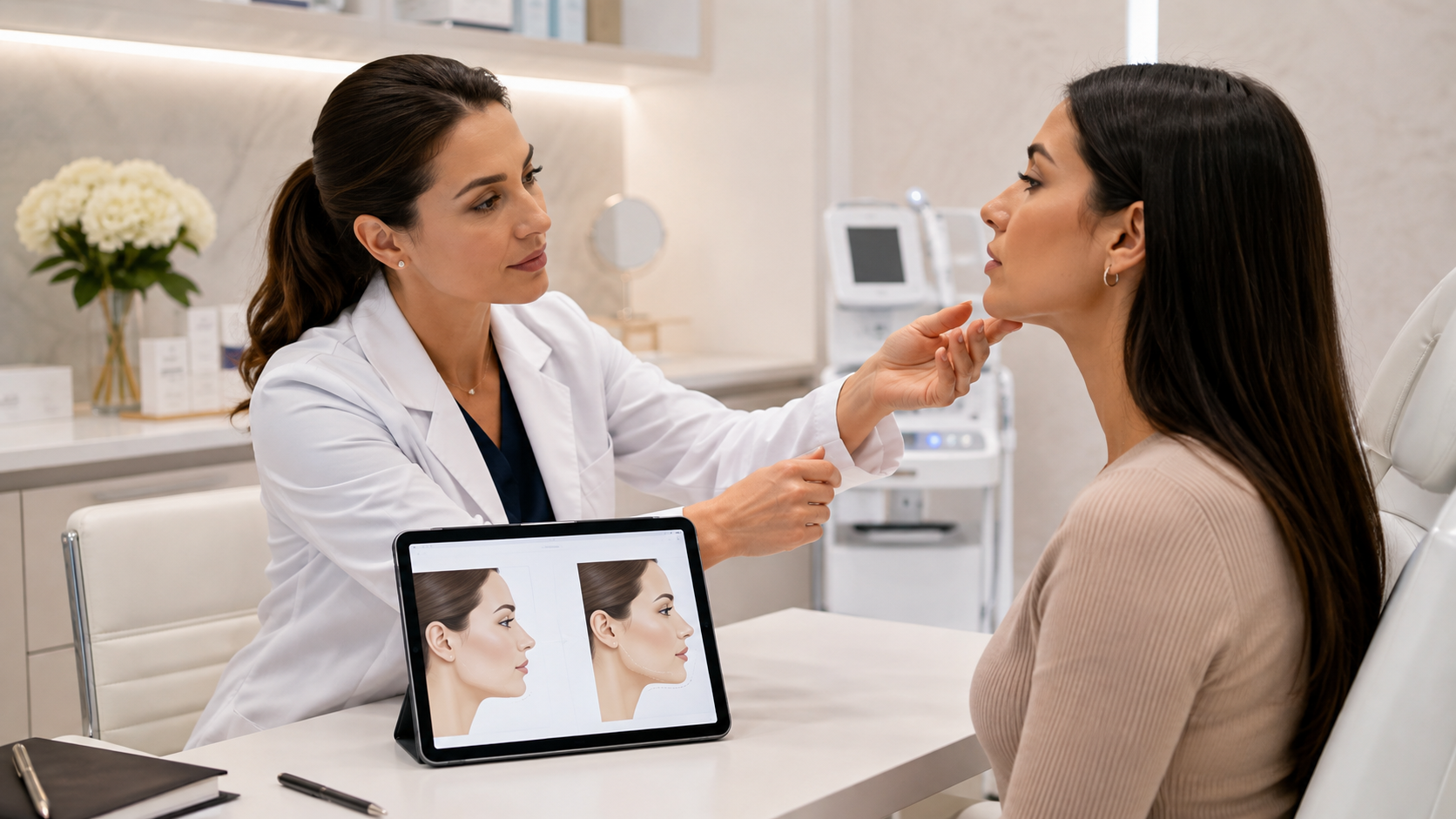
Chin augmentation is often considered alongside procedures intended to improve overall facial balance, such as rhinoplasty, since chin projection directly affects how the nose is perceived in profile.
It may also be planned together with broader jawline or facial contouring for a more complete lower-face result, when a patient's underlying anatomy calls for correction beyond the chin alone.
Patients whose main concern is overall facial harmony, rather than the chin in isolation, may also consider the clinic's Forehead Contouring options, since forehead projection and chin projection are both judged in relation to the rest of the facial profile.
Whether to combine chin augmentation with another procedure in a single surgical session, or to stage the procedures separately, depends on the patient's anatomy, overall health, and the combined anesthesia and recovery time involved, and is assessed individually rather than offered as a fixed package.
Combining chin augmentation with a complementary procedure in the same session can reduce the total number of trips required for international patients, which matters when travel and recovery time must be planned around a single visit to Seoul. At the same time, combining too many structural procedures into one surgical session can extend total anesthesia time and lengthen overall recovery, so Dr. Choi weighs the specific combination against the patient's general health and each procedure's individual healing requirements before recommending whether to combine or stage treatments.
Safety, Precision, and Clinic Standards
Good-Line Plastic Surgery Clinic is a Registered Medical Institution for Attracting Foreign Patients, certified by Korea's Ministry of Health and Welfare under the Medical Overseas Expansion and Foreign Patients Attraction Act. Dr. Choi deokho is a full member of the Korean Society of Plastic and Reconstructive Surgeons. Every chin augmentation patient undergoes an individual assessment of facial proportions, chin projection, and medical history, with photographs and, when clinically appropriate, additional imaging or measurements used to plan implant size or the surgical approach. As with any facial bone or soft-tissue surgery, possible risks include swelling, bruising, temporary numbness or altered sensation around the chin or lower lip, asymmetry, infection, bleeding, scarring, and, specifically with implants, displacement or malposition (see ASPS Chin Surgery). Bone-based sliding genioplasty carries additional surgical risks specific to the technique, and outcomes depend substantially on individual anatomy and healing, which is why a consultation with the surgeon is required to review individual risk before proceeding.
Sterile surgical technique and careful implant or technique selection for each patient's anatomy are treated as baseline requirements rather than differentiators at the clinic. Postoperative risk reduction relies as much on scheduled follow-up monitoring as on the surgery itself, since a missed follow-up visit can delay identification of a complication — such as early implant displacement or a wound-healing issue — that would otherwise be manageable if caught early. Patients are encouraged to contact the clinic promptly if they notice severe pain, increasing swelling, fever, unusual drainage, or other concerning symptoms, rather than waiting for the next scheduled appointment.
The Bottom Line
Chin augmentation at Good-Line Plastic Surgery Clinic uses either a chin implant or, in selected cases, sliding genioplasty, with the choice based on individual chin projection and bone structure.
The procedure commonly takes about 1-2 hours under local anesthesia with sedation or general anesthesia, depending on the technique and any combined procedures.
A properly placed implant or healed bone segment is generally considered to provide long-term augmentation, though results can change with aging, weight changes, injury, or future surgery.
Reviewed and performed under Dr. Choi deokho, a board-registered, experienced plastic surgeon with roughly 25 years at the clinic.
Often combined with rhinoplasty, jawline contouring, or forehead contouring when a patient's goal is comprehensive facial balance rather than a single isolated change.
Frequently Asked Questions
What is chin augmentation? Chin augmentation is a cosmetic procedure designed to improve the size, projection, or overall shape of the chin, using either a synthetic chin implant placed over the existing bone or, in selected cases, sliding genioplasty, which repositions and secures a cut segment of the chin bone itself.
Am I a good candidate for chin augmentation? Adults with a relatively weak or recessed chin who are in generally good health and have realistic expectations about improved facial proportion may be good candidates. Patients with uncontrolled medical conditions, active infection near the treatment area, significant dental or oral issues, or an underlying jaw-relationship concern that needs separate correction may not be suitable for straightforward chin augmentation until these issues are addressed.
What is the difference between a chin implant and sliding genioplasty? A chin implant adds projection and definition over the existing chin bone without cutting it, and is generally a shorter, less invasive procedure. Sliding genioplasty cuts, repositions, and secures a section of the chin bone itself, allowing correction of more complex concerns such as asymmetry or a vertical-height discrepancy that an implant alone cannot address.
Is chin augmentation painful, and what anesthesia is used? Chin augmentation is surgery, so some discomfort, tightness, and swelling around the chin and lower lip are expected during recovery, generally managed with prescribed pain medication. Depending on the technique, local anesthesia with sedation or general anesthesia may be used, with the exact plan confirmed with the surgeon.
How long does chin augmentation surgery take, and what is the recovery timeline? Chin augmentation commonly takes about 1-2 hours, depending on the technique and whether other procedures are performed at the same time. Swelling and bruising are usually most noticeable during the first several days and gradually improve over 1-2 weeks, with residual swelling and final contour continuing to settle over several weeks to a few months.
When will I see results, and how long do they last? Some change in chin projection can be noticeable soon after surgery, though early swelling affects the appearance; the final contour becomes clearer as swelling resolves, typically over several weeks. A properly placed implant or a healed, repositioned bone segment is generally considered to provide long-term augmentation, though results can change over time with aging, weight change, injury, or future surgery.
What are the risks of chin augmentation? Possible risks include swelling, bruising, temporary numbness or altered sensation, asymmetry, infection, bleeding, scarring, and, specific to implants, displacement or malposition. Sliding genioplasty carries additional surgical risks associated with bone-based procedures. A consultation with the surgeon is required to review individual risk factors before proceeding.
How many days should I plan to stay in Korea for chin augmentation? As a general guide, international patients commonly allow approximately 7-10 days for surgery, suture removal where applicable, and early follow-up, though the exact length of stay depends on the technique used and individual healing, and should be confirmed directly with the clinic.
Can chin augmentation be combined with other procedures? Yes — chin augmentation is often planned alongside rhinoplasty, jawline contouring, or other facial contouring procedures for patients whose goal is overall facial balance rather than a single isolated change. Whether combining procedures in one session is appropriate depends on the patient's anatomy, overall health, and total anesthesia and recovery time, and is assessed individually at consultation.
Book a Consultation at Good-Line Plastic Surgery Clinic

To discuss whether a chin implant, sliding genioplasty, or a combination of chin augmentation with another facial contouring procedure best fits your profile and goals, contact Good-Line Plastic Surgery Clinic in Gangnam-gu, Seoul at +82 2 543 1830 or through the clinic's online contact form. A consultation with Dr. Choi deokho, including a review of facial proportions and chin projection, is the only reliable way to determine which technique fits your specific anatomy and aesthetic goals.
Disclaimer
This page is for general informational purposes and does not constitute individualized medical advice. Candidacy, technique, and expected outcomes can only be determined through a consultation with a qualified physician.
Sources & Further Reading
Other Services
Explore additional treatments offered by our specialists.

Under-Eye Fat Repositioning
Under-eye fat repositioning is a transconjunctival lower-eyelid procedure that redistributes — rather than discards — the fat compartments beneath the eye, moving them around the orbital bone to correct hollowing and bulging caused by aging skeletal and.
Learn More

TRIPLE CELL
TRIPLE CELL is a non-invasive, radiofrequency-based skin treatment designed to deliver energy into different layers of the skin to support hydration, elasticity, and collagen-related skin recovery.
Learn More

Thermage Skin Tightening
Thermage Skin Tightening is a non-surgical radiofrequency treatment that heats targeted tissue beneath the skin to stimulate collagen remodeling, improving the appearance of mild-to-moderate skin laxity.
Learn More