Natural-Looking Face & Neck Lift Surgery and Personalized Anti-Aging Care in Apgujeong, Gangnam, Seoul
4.1 ★ Google · Board-Certified Plastic Surgeon
en-US

Fat Grafting · Consultation Required
Facial Fat Grafting
Facial fat grafting is a two-part procedure that harvests a patient's own fat from a donor area, processes it, and reinjects it into the face to restore volume and improve contour using living tissue rather than a synthetic material.
Schedule a Consultation
Facial Fat Grafting

Reviewer Details
Medically reviewed by Dr. Choi deokho, Representative Director & Plastic Surgeon, Good-Line Plastic Surgery Clinic.
Registered as the clinic's legal representative in the Korean National Tax Service registry, Full Member of the Korean Society of Plastic and Reconstructive Surgeons · Last reviewed 2026-08-18 · Good-Line Plastic Surgery Clinic, Gangnam-gu, Seoul.
Facial fat grafting at Good-Line Plastic Surgery Clinic uses a patient's own fat, harvested from another area of the body, processed to concentrate viable fat cells, and injected into selected facial areas to restore lost volume and improve facial contour. It is planned individually according to how much facial volume is missing, which areas are affected, and how much donor fat is realistically available for harvesting.
What Is Facial Fat Grafting?
Facial fat grafting is a two-part procedure that harvests a patient's own fat from a donor area, processes it, and reinjects it into the face to restore volume and improve contour using living tissue rather than a synthetic material.
Fat is typically harvested by liposuction from a donor area with sufficient excess fat, such as the abdomen, thighs, or buttocks.
Harvested fat is generally processed through centrifugation to concentrate viable fat cells and remove excess fluid and oil before reinjection.
Fat is reinjected using a disposable cannula, with the clinic describing careful attention to the patient's desired facial design before treatment begins.
Micro-fat transplantation, using a finer cannula and smaller fat parcels, is applied to more delicate facial areas where precise, controlled placement matters more than sheer volume.
The clinic identifies the first four to five days after treatment as a particularly important period for fat engraftment, and describes using highly concentrated vitamin C during this window to support wound healing.
Facial fat grafting differs from dermal fillers and facial implants in one key respect: it uses the patient's own living tissue rather than a manufactured material, which requires a donor-site harvesting step that fillers and implants do not need. Because some of the transferred fat is naturally reabsorbed by the body over the following months, the eventual retained facial volume is not identical to what is visible immediately after the injection — the surviving, stabilized volume is what ultimately determines the result.
Who Performs Facial Fat Grafting at Good-Line Plastic Surgery Clinic

Dr. Choi deokho
Representative Director and plastic surgeon
Dr. Choi deokho is the Representative Director and plastic surgeon at Good-Line Plastic Surgery Clinic, with approximately 25 years associated with the clinic since its establishment in 2001. His stated core specializations include facial plastic surgery, rhinoplasty, facial contouring, and anti-aging and lifting procedures, with facial fat grafting used as one of the tools within this broader facial-rejuvenation practice to restore volume using the patient's own tissue. He holds full membership in the Korean Society of Plastic and Reconstructive Surgeons, the Korean Society for Microsurgery, the Korean Cleft Palate-Craniofacial Association, the Japan Society of Aesthetic Plastic Surgery, the American Society of Aesthetic Plastic Surgery, and the International Society of Aesthetic Plastic Surgery. Every facial fat grafting patient is evaluated individually for facial proportions, the specific areas requiring added volume, available donor-fat sites, and the patient's own stated facial design goals before a treatment plan is finalized.
Because facial volume loss can appear very differently from one patient to the next — some show hollowing concentrated at the cheeks, others at the temples, and others across a broader area — Dr. Choi's evaluation places real weight on mapping exactly where volume is missing before recommending a plan, rather than applying one default injection pattern to every face. A patient with limited donor fat at the usual harvesting sites is assessed differently from a patient with ample donor fat at the abdomen or thighs, since the achievable outcome and the feasibility of the more delicate micro-fat transplantation technique depend directly on how much viable fat can be harvested and how well it survives after transfer.
Facial Fat Grafting Options Available
Standard Fat Transplantation | Micro-Fat Transplantation |
|---|---|
Uses a standard disposable cannula to harvest and inject centrifuged fat in larger volumes | Uses a finer cannula and smaller, more precisely placed fat parcels to minimize tissue trauma |
Suited to areas with more pronounced volume loss, such as sunken cheeks, hollow temples, or broader facial contour restoration | Suited to delicate areas requiring subtle, controlled placement rather than bulk volume |
Typically used when the goal is a more comprehensive change to facial fullness and three-dimensional structure | Typically used to fine-tune contour transitions and avoid an over-filled or lumpy appearance in sensitive zones |
Both approaches begin with the same harvesting and centrifugation process; the difference lies in cannula size, injection pattern, and the amount of fat placed per pass. A single session commonly combines both techniques — standard volumizing across the cheeks or temples paired with micro-fat transplantation at contour transitions — rather than using only one method across the entire face. The clinic states that careful attention is given to the patient's desired facial design before treatment, since the balance between standard and micro-fat placement affects the final facial proportions as much as the total volume of fat transferred.
Patients frequently ask how facial fat grafting compares with dermal fillers or facial implants. Dermal fillers use a manufactured, injectable material, require no donor-site harvesting, and often suit smaller-volume corrections; facial implants provide structural augmentation through an inserted device rather than living tissue. Facial fat grafting uses the patient's own harvested fat and can address multiple facial areas within a single procedure, though it requires the additional donor-site liposuction step that fillers and implants do not.
Who Is a Good Candidate for Facial Fat Grafting?
Adults with facial volume loss, hollow or sunken cheeks or temples, or an overall thin, aging facial appearance who want to use their own tissue rather than a synthetic material.
Patients whose face has become sunken or shows volume-related wrinkling due to aging, significant weight loss, or long-term lifestyle factors.
Patients seeking a more natural-feeling, longer-term alternative to dermal fillers for facial volume restoration, with realistic expectations about partial fat reabsorption.
Patients with sufficient donor fat at an available harvesting site, such as the abdomen, thighs, or buttocks.
Generally healthy adults without active infection or an uncontrolled medical condition that would make elective surgery unsafe.
Not generally suitable candidates: patients with insufficient donor fat, unstable body weight, active infection, or significant healing-risk factors, until these are addressed; pregnancy and breastfeeding may also require postponing treatment.
Patients with unrealistic expectations about guaranteed fat survival or a permanent, unchanging result should discuss expectations candidly with the surgeon before proceeding.
What to Expect: Procedure, Recovery, and Results Timeline
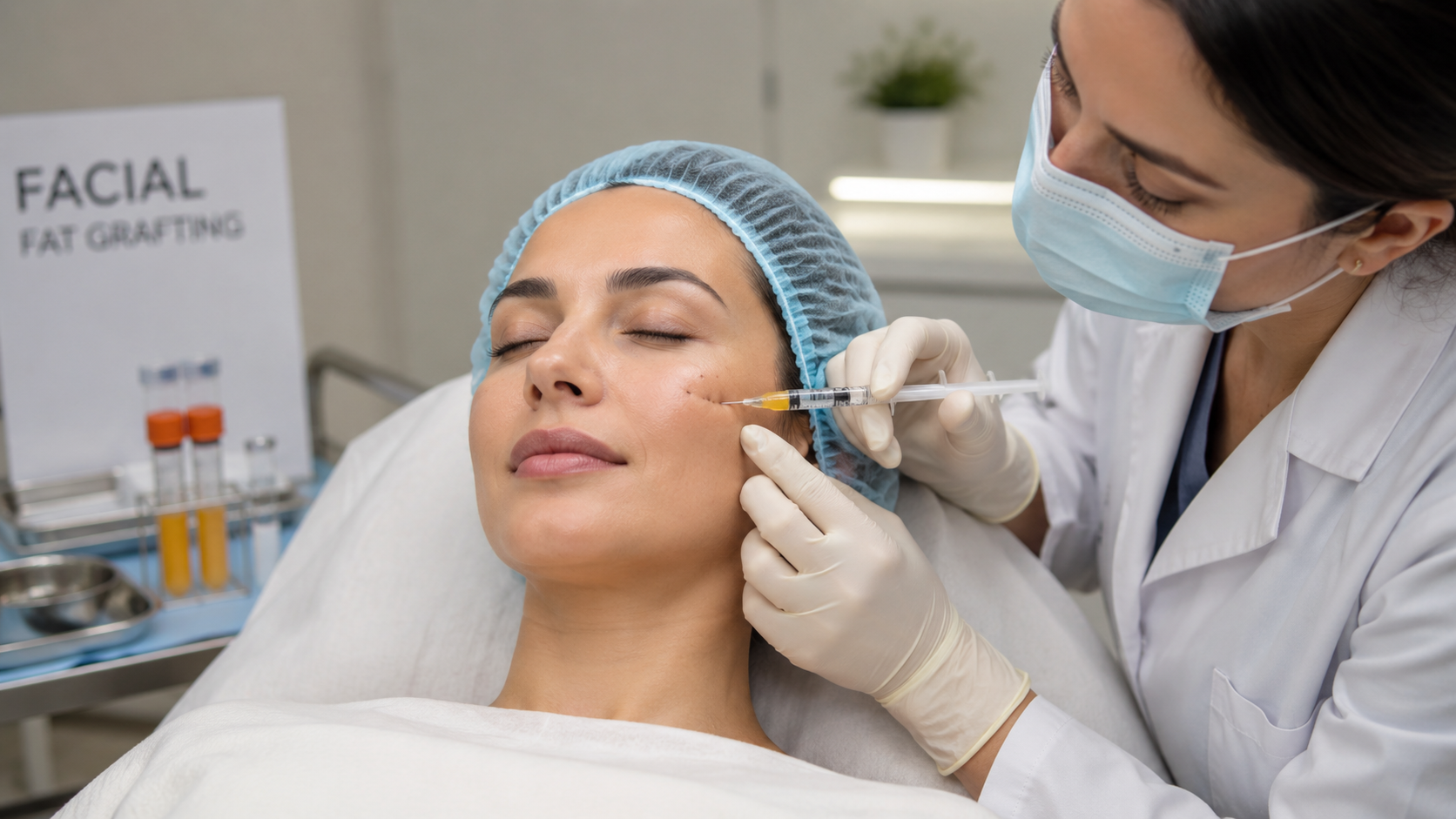
Facial fat grafting always involves two connected steps performed in the same session: liposuction harvesting at the donor site, followed by processing and reinjection of the graft into the face. Anesthesia ranges from local anesthesia alone to sedation or general anesthesia, chosen according to the amount of fat harvested, the number of facial areas treated, and whether other procedures are combined in the same session; the procedure itself commonly takes several hours depending on these factors.
Stage | What typically happens |
|---|---|
Day 0 | Fat is harvested by liposuction from the donor site, processed by centrifugation, and injected into the face with a disposable cannula under the planned anesthesia |
Day 1-3 | Swelling, bruising, and tenderness are most noticeable at both the donor and facial injection sites |
Day 5-10 | The clinic identifies the first four to five days as a particularly important engraftment window, supported by concentrated vitamin C; swelling generally begins to recede but the face still appears fuller than the eventual result |
Week 4-8 | Swelling continues to resolve and some transferred fat is naturally reabsorbed; the visible outcome becomes progressively more representative of the final volume |
Month 12+ | Surviving, engrafted fat behaves like the patient's own facial tissue and can provide long-lasting volume, though a portion of the original transferred amount will have been reabsorbed over the preceding months and the result should be described as potentially long-lasting rather than guaranteed permanent |
Before treatment, patients are generally asked for a full medical history and current medication list, with particular attention to any medication or supplement that increases bleeding risk, reviewed and adjusted only on the surgeon's advice. Smoking is discouraged because it affects healing at both the donor and injection sites, and patients should arrange transportation home if sedation or general anesthesia is used. Aftercare generally includes protecting the treated facial area from unnecessary pressure, monitoring swelling and bruising, and attending scheduled follow-up visits so that any unusual asymmetry or contour irregularity can be identified early.
Results develop gradually rather than all at once. An initial change in facial volume is visible soon after treatment, but early swelling can make the face look fuller than the eventual outcome will be. As swelling decreases and some transferred fat is reabsorbed over the following weeks and months, the appearance becomes progressively more representative of the final, stabilized result — generally assessed only after several months.
Combining Facial Fat Grafting with Other Treatments
Facial fat grafting may be combined with other facial rejuvenation or contouring procedures in the same session when both volume loss and skin or tissue laxity need to be addressed together.
Because donor fat is commonly harvested from the abdomen, thighs, or buttocks, the harvesting step can double as a light contouring benefit at the donor area while facial volume is restored at the same time.
Patients whose primary concern is under-eye hollowing, rather than the cheeks or temples, may want to compare facial fat grafting with the clinic's dedicated Under-Eye Micro Fat Grafting procedure, which sources fat specifically from the lower abdomen for the more delicate under-eye area.
Patients considering a broader facial-rejuvenation plan may also review the clinic's Fat Grafting specialty page, which covers hand fat grafting and larger-scale body-to-face fat transfer alongside facial fat grafting.
Whether to combine facial fat grafting with another procedure in the same session, rather than staging separate visits, depends on overall health, total anesthesia time, and each procedure's individual healing needs — a decision made individually with the surgeon. This consideration matters particularly for international patients who are planning travel dates around a single recovery period rather than multiple separate visits to Korea.
Safety, Precision, and Clinic Standards
Good-Line Plastic Surgery Clinic is a Registered Medical Institution for Attracting Foreign Patients, certified by Korea's Ministry of Health and Welfare under the Medical Overseas Expansion and Foreign Patients Attraction Act. Dr. Choi deokho is a full member of the Korean Society of Plastic and Reconstructive Surgeons. Every facial fat grafting patient is assessed individually for facial proportions, donor-fat availability, and medical history before a treatment plan is finalized. As with any harvesting-and-reinjection procedure, temporary swelling, bruising, tenderness, and mild asymmetry at both the donor and facial sites are common and expected during early recovery. Less common risks include infection, contour irregularity, fat necrosis, cyst formation, and over- or under-correction; rare but serious vascular complications associated with facial fat injection should be discussed individually with the surgeon (see ASPS — Fat Grafting).
Risk reduction in facial fat grafting relies on more than injection technique alone. The clinic states that it uses disposable cannulas for both harvesting and injection, takes considerable time to plan the facial design before treatment, uses unfrozen fat rather than previously frozen tissue, and applies highly concentrated vitamin C during the early engraftment period. Controlled injection of small amounts of fat per pass, rather than large boluses, together with sterile technique and consistent postoperative monitoring, is treated as standard practice rather than an optional add-on. Scheduled follow-up visits are built into the treatment plan, since early identification of unusual swelling, firmness, or asymmetry generally allows simpler management than addressing the same issue later. Patients are encouraged to report unusual pain, rapidly worsening swelling, or any vision change promptly rather than waiting for the next appointment.
The Bottom Line
Facial fat grafting at Good-Line uses a patient's own harvested fat, processed by centrifugation and reinjected with a disposable cannula, to restore volume to sunken cheeks, temples, or overall facial contour.
Standard fat transplantation and micro-fat transplantation are typically combined within a single session, matched to how much volume is needed in each area of the face.
Reviewed and performed under Dr. Choi deokho, an experienced plastic surgeon with roughly 25 years at the clinic.
Because some transferred fat is naturally reabsorbed, the final facial result develops gradually over several months and cannot be guaranteed to match the day-of-surgery appearance.
Facial fat grafting differs from dermal fillers and implants by using the patient's own living tissue, which requires a donor-site harvesting step those alternatives do not need.
Frequently Asked Questions
How is facial fat grafting different from getting dermal filler in my cheeks or temples? Dermal filler uses a manufactured, injectable material and requires no harvesting step, often making it faster for smaller corrections. Facial fat grafting uses your own fat, harvested by liposuction, processed by centrifugation, and reinjected into the face — it can address a broader area in one procedure but adds donor-site recovery on top of facial recovery.
Will my face look overfilled right after facial fat grafting? Some early fullness beyond the eventual result is expected and is largely due to post-procedure swelling rather than the actual transferred fat volume. As swelling resolves and some transferred fat is naturally reabsorbed, the face gradually settles into a more representative, stabilized appearance.
Why does the clinic emphasize the first four to five days after treatment? The clinic identifies the first four to five days after facial fat grafting as a particularly important window for fat engraftment — the period when transferred fat cells establish a blood supply in their new location. The clinic describes using highly concentrated vitamin C during this window to support wound healing.
How much of the transferred fat will actually stay in my face? Some portion of any facial fat graft is naturally reabsorbed over the following months; this is normal rather than a complication. The surviving, engrafted fat can then provide long-lasting volume, though the exact retained amount varies between patients and cannot be predicted or guaranteed in advance.
What is the difference between standard fat transplantation and micro-fat transplantation for the face? Standard fat transplantation uses larger fat parcels and a standard cannula, suited to areas needing more substantial volume such as sunken cheeks or temples. Micro-fat transplantation uses a finer cannula and smaller fat parcels for precisely controlled placement, and the two are commonly combined within one session depending on which areas need volume.
Can facial fat grafting be combined with other facial procedures in one visit? In many cases, yes — it is often combined with other facial rejuvenation or contouring procedures in the same session when both volume loss and skin or tissue laxity need addressing. Whether combining procedures is appropriate depends on overall health, anesthesia time, and healing needs, decided individually at consultation.
Is facial fat grafting painful, and what anesthesia is used? Discomfort during the procedure is generally controlled with local anesthesia, sedation, or general anesthesia, chosen according to the amount of fat harvested and the extent of areas treated. Afterward, soreness, tightness, swelling, and bruising at both sites are common and generally manageable with the surgeon's recommended aftercare.
Is English-language consultation available for facial fat grafting? Yes, Good-Line Plastic Surgery Clinic offers English-language support and an online contact channel for international patients, alongside a multilingual clinic website covering Korean, English, Chinese, and Japanese.
Book a Consultation at Good-Line Plastic Surgery Clinic

To find out whether standard fat transplantation, micro-fat transplantation, or a combination best suits your facial volume goals, contact Good-Line Plastic Surgery Clinic in Gangnam-gu, Seoul at +82 2 543 1830 or through the clinic's online contact form. A consultation with the surgeon is the only reliable way to determine how much donor fat you have available, which facial areas need volume, and which technique combination fits your goals.
Disclaimer
This page is for general informational purposes and does not constitute individualized medical advice. Candidacy, technique, and expected outcomes can only be determined through a consultation with a qualified physician.
Sources & Further Reading
Other Services
Explore additional treatments offered by our specialists.
Under-Eye Fat Repositioning
Under-eye fat repositioning is a transconjunctival lower-eyelid procedure that redistributes — rather than discards — the fat compartments beneath the eye, moving them around the orbital bone to correct hollowing and bulging caused by aging skeletal and.
Learn More

TRIPLE CELL
TRIPLE CELL is a non-invasive, radiofrequency-based skin treatment designed to deliver energy into different layers of the skin to support hydration, elasticity, and collagen-related skin recovery.
Learn More

Thermage Skin Tightening
Thermage Skin Tightening is a non-surgical radiofrequency treatment that heats targeted tissue beneath the skin to stimulate collagen remodeling, improving the appearance of mild-to-moderate skin laxity.
Learn More