Natural-Looking Face & Neck Lift Surgery and Personalized Anti-Aging Care in Apgujeong, Gangnam, Seoul
4.1 ★ Google · Board-Certified Plastic Surgeon
en-US

Facial Contouring Surgery · Consultation Required
Forehead Contouring
Forehead contouring reshapes the forehead's underlying bone or adds targeted volume through an implant, filler, or fat graft to correct a concern about forehead width, projection, or shape and to improve harmony with the eyes, nose, and midface.
Schedule a Consultation
Forehead Contouring

Reviewer Details
Medically reviewed by Dr. Choi deokho, Representative Director & Plastic Surgeon, Good-Line Plastic Surgery Clinic.
Registered as the clinic's legal representative in the Korean National Tax Service registry, Full Member of the Korean Society of Plastic and Reconstructive Surgeons · Last reviewed 2026-08-18 · Good-Line Plastic Surgery Clinic, Gangnam-gu, Seoul.
Forehead contouring at Good-Line Plastic Surgery Clinic in Seoul is a cosmetic procedure intended to improve the shape, projection, and overall balance of the forehead. It is offered as both a non-surgical, filler- or fat-based approach and a surgical, bone-based approach, with the appropriate option determined by the patient's specific forehead anatomy and goals.
What Is Forehead Contouring?
Forehead contouring reshapes the forehead's underlying bone or adds targeted volume through an implant, filler, or fat graft to correct a concern about forehead width, projection, or shape and to improve harmony with the eyes, nose, and midface.
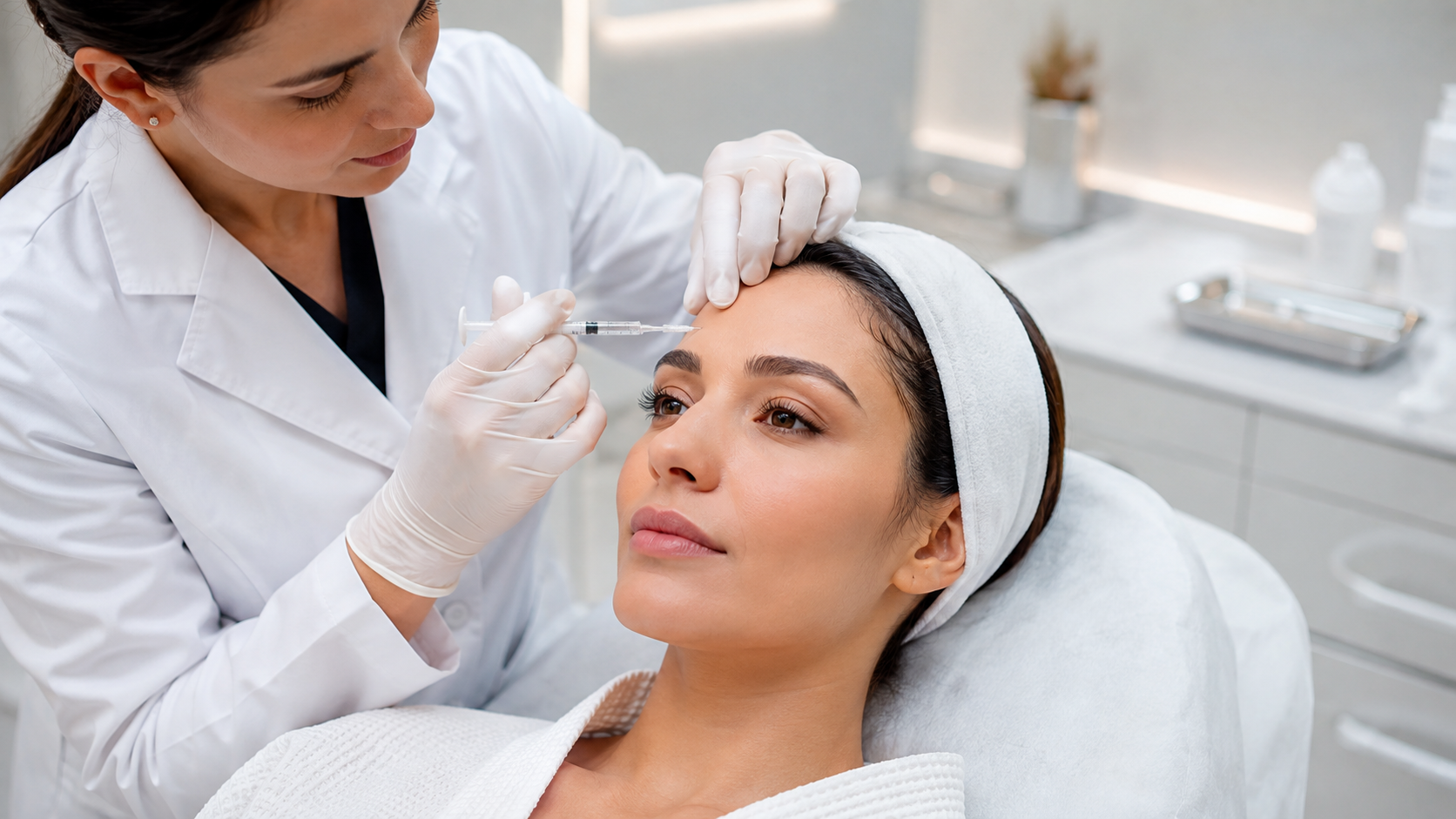
Non-surgical options rely on injectable fillers or fat grafting to add volume to a flat or recessed forehead area.
Surgical options reshape the frontal bone directly, through reduction of excess bony projection or augmentation with an implant, to achieve a more structural, lasting change.
Technique selection depends on forehead and brow anatomy, skin and bone structure, and the patient's desired outcome, assessed individually at consultation.
Non-surgical treatment generally requires little or no anesthesia, while surgical forehead contouring may use local anesthesia with sedation or general anesthesia depending on the extent of correction.
Both approaches are intended to improve overall facial harmony rather than to create a single fixed "ideal" forehead shape.
Who Performs Forehead Contouring at Good-Line Plastic Surgery Clinic

Dr. Choi deokho
Representative Director and plastic surgeon
Dr. Choi deokho is the Representative Director and plastic surgeon at Good-Line Plastic Surgery Clinic, with approximately 25 years associated with the clinic since its establishment in 2001. His stated core specializations include facial plastic surgery, rhinoplasty, facial contouring, and anti-aging and lifting procedures, and forehead contouring is evaluated within this broader facial contouring practice rather than as an isolated, stand-alone offering. He holds full membership in the Korean Society of Plastic and Reconstructive Surgeons, the Korean Society for Microsurgery, the Korean Cleft Palate-Craniofacial Association, the Japan Society of Aesthetic Plastic Surgery, the American Society of Aesthetic Plastic Surgery, and the International Society of Aesthetic Plastic Surgery. Patients considering forehead contouring are evaluated for facial proportions, forehead and brow anatomy, skin and bone structure, medical history, and desired outcome before a specific technique is recommended.
Because forehead concerns can stem from very different underlying causes — a genuinely flat or under-projected bone structure, a naturally prominent or bossed frontal bone, or simply soft-tissue volume loss over the brow — Dr. Choi's evaluation process places particular weight on identifying which of these is actually driving a patient's concern before proposing a plan. A patient who assumes they need a surgical bone procedure may, on examination, be better served by a non-surgical filler or fat-grafting approach, and vice versa, since forehead proportion is judged in relation to the eyes, nose, and midface together rather than in isolation. This distinction is treated as a core part of the consultation, not a formality before booking a fixed procedure.
Forehead Contouring Options Available
Non-Surgical Forehead Contouring (Filler / Fat Grafting) | Surgical Forehead Contouring (Bone Reduction or Implant Augmentation) |
|---|---|
Adds volume to a flat, recessed, or asymmetric forehead area using dermal filler or fat grafting | Reshapes the frontal bone directly — reducing excess bony projection or augmenting it with a structural implant |
Best for milder volume-related concerns or as a first step before considering surgery | Best for a clearly defined structural concern about forehead shape, width, or projection tied to the underlying bone |
Generally requires little or no anesthesia; commonly takes about 30-60 minutes | Uses local anesthesia with sedation or general anesthesia depending on the extent of correction; surgical contouring takes longer than the non-surgical option |
Results can be revisited or adjusted over time as filler resorbs or fat volume changes | Bone- and implant-based changes are intended to be structural and long-lasting once healing is complete |
Beyond these two named approaches, alternatives such as brow or forehead lifting and hairline-related procedures may also be considered for certain concerns, though these address soft-tissue position and hairline appearance rather than the underlying bone itself and are not equivalent to structural bone contouring. Non-surgical fillers and fat grafting are generally suited to patients whose main concern is volume — a forehead that appears flat, hollow, or slightly recessed — while surgical bone reduction or implant augmentation is generally reserved for patients whose forehead shape is driven by the frontal bone itself, whether that means excess bony prominence that needs reducing or insufficient projection that benefits from a structural implant.
Choosing between these approaches is not simply a matter of which sounds more effective — the underlying cause of the forehead concern constrains which option will hold up over time. A patient whose forehead appears underprojected purely from soft-tissue volume loss may achieve a satisfying, lower-downtime result with filler or fat grafting alone, while a patient whose concern is a genuinely prominent or irregular frontal bone is generally better served by surgical reduction or augmentation, since injectable volume cannot reshape bone itself. This is why the surgeon's direct examination of forehead and brow anatomy — rather than a fixed menu selection — determines which combination of techniques is recommended for a given patient.
Who Is a Good Candidate for Forehead Contouring?
Adults concerned about forehead shape, contour, width, or projection who are in suitable general health and have realistic expectations about the degree of change achievable.
Patients with a stable facial structure and a clearly defined concern about forehead shape rather than a vague or shifting request.
Patients whose forehead concern is primarily volume-related (flat or recessed appearance) may be suitable for the non-surgical filler or fat-grafting option.
Patients whose concern is tied to the underlying frontal bone — either excess prominence or insufficient projection — are typically evaluated for the surgical bone reduction or implant augmentation option.
Generally healthy individuals medically fit for the chosen anesthesia approach, without active infection and without significant scalp or forehead problems.
Not suitable candidates generally include those with active infection, uncontrolled medical conditions, significant scalp or forehead healing problems, or unrealistic expectations, until these issues are medically addressed.
Patients who are pregnant or not medically fit for anesthesia are generally not suitable candidates for the surgical option until these issues are resolved.
What to Expect: Procedure, Recovery, and Results Timeline
Anesthesia depends on the technique: non-surgical filler or fat-grafting treatment generally requires little or no anesthesia, while surgical forehead contouring may use local anesthesia with sedation or general anesthesia depending on the extent of correction; the exact plan is confirmed with the surgeon based on which approach is selected.
Stage | What typically happens |
|---|---|
Day 0 | Forehead and brow anatomy assessed and confirmed; anesthesia administered according to the chosen approach; filler/fat-grafting placement or bone reshaping and implant placement performed as planned |
Day 1-3 | Swelling, bruising, and tenderness are most noticeable during this window, particularly after the surgical option |
Day 5-10 | Non-surgical patients generally see swelling settle considerably; surgical patients continue active early healing and may have a follow-up visit for wound check |
Week 4-8 | Non-surgical results generally stabilize; surgical swelling has substantially resolved and the initial contour becomes clearer |
Month 12+ | Bone- and implant-based structural results are considered long-lasting; non-surgical filler or fat-grafting results vary in how long their effect is maintained and may require touch-up over time |
Before surgery, patients are generally asked to provide a complete medical history, including medications, allergies, and any previous facial procedures, and to follow the surgeon's instructions regarding smoking, alcohol, and any aspirin or anti-inflammatory medicines and supplements that can increase bleeding or bruising risk. For the non-surgical option, preparation is comparatively minimal, though the same disclosure of medical history and any known filler allergies is still expected. Aftercare after surgical forehead contouring commonly includes wound-care instructions, keeping the surgical area protected, managing swelling as directed, avoiding strenuous activity in the initial recovery period, and attending scheduled follow-up visits; aftercare after non-surgical treatment is generally lighter, focusing on avoiding unnecessary pressure on the treated area in the days immediately following injection.
International patients evaluating forehead contouring in Seoul commonly weigh the accreditation of Korean clinics, the availability of language support during consultation and aftercare, and how remote follow-up will be handled once they return home. For non-surgical treatment, an extended stay in Korea is generally unnecessary. For the surgical option, international patients may need approximately 7-14 days for early follow-up and recovery, though the exact period depends on the specific technique used and should always be confirmed individually with the surgeon rather than assumed from a general guideline. Good-Line Plastic Surgery Clinic offers English-language consultation and an online contact channel for international patients considering either approach.
Combining Forehead Contouring with Other Treatments
Forehead procedures may sometimes be combined with other facial contouring procedures, such as Chin Augmentation, when doing so improves overall facial balance rather than addressing the forehead in isolation.
Facial contouring as a category is frequently combined with rhinoplasty, since forehead, chin, and nasal proportion are judged together when assessing profile balance.
Combining forehead contouring with eye surgery or broader facial contouring may also be considered when a patient's overall goal is comprehensive facial harmony rather than a single isolated change.
Suitability for any combination must be assessed individually, since combining procedures within one session can reduce total recovery time and travel trips but may also extend anesthesia time depending on the specific combination chosen.
Patients interested in a broader facial-balancing plan may also review the clinic's Facial Contouring Surgery page for the full range of related options.
Safety, Precision, and Clinic Standards
Good-Line Plastic Surgery Clinic is a Registered Medical Institution for Attracting Foreign Patients, certified by Korea's Ministry of Health and Welfare under the Medical Overseas Expansion and Foreign Patients Attraction Act. Dr. Choi deokho is a full member of the Korean Society of Plastic and Reconstructive Surgeons. Forehead contouring patients are assessed individually for facial proportions, forehead and brow anatomy, and skin and bone structure before a treatment plan is confirmed. A complete review of medical history and current medications is required before either the non-surgical or surgical option proceeds. Possible surgical risks include swelling, bruising, bleeding, infection, numbness or other sensory changes, scarring, asymmetry, hair loss around an incision, and anesthesia-related complications, while non-surgical treatment carries its own separate set of injection-related risks that the surgeon reviews individually (see ASPS Brow Lift). Because the surgical option can involve direct work on the frontal bone near the frontal sinus, appropriate technique selection and careful anatomical planning are treated as baseline requirements rather than differentiators. Postoperative risk reduction relies as much on scheduled follow-up monitoring as on the procedure itself, and patients are encouraged to raise any concerning symptom — such as unusual pain, sensory change, or asymmetric swelling — promptly rather than waiting for the next scheduled appointment.
The Bottom Line
Forehead contouring at Good-Line is available as a non-surgical filler/fat-grafting option or a surgical bone reduction/implant augmentation option.
Technique choice depends on whether the concern is volume-related or tied to the underlying frontal bone — not a single default approach applied to every patient.
Bone- and implant-based results are considered long-lasting, while non-surgical filler or fat-grafting results vary in how long their effect is maintained.
Reviewed and performed under Dr. Choi deokho, a board-registered, experienced plastic surgeon with roughly 25 years at the clinic.
Combining forehead contouring with chin augmentation, rhinoplasty, or other facial contouring procedures is common when the overall goal is comprehensive facial harmony.
Frequently Asked Questions
What is forehead contouring? Forehead contouring is a cosmetic procedure intended to improve the shape, projection, and overall balance of the forehead, offered both as a non-surgical filler or fat-grafting treatment and as a surgical bone reduction or implant augmentation procedure, depending on the patient's anatomy and goals.
Am I a good candidate for forehead contouring? Good candidates are generally healthy adults with a stable facial structure and a clearly defined concern about forehead shape, width, or projection who have realistic expectations. Patients with active infection, uncontrolled medical conditions, significant scalp or forehead problems, or unrealistic expectations are generally not suitable until these issues are medically addressed.
What is the difference between non-surgical and surgical forehead contouring? Non-surgical forehead contouring uses dermal filler or fat grafting to add volume to a flat or recessed forehead and generally requires little or no anesthesia. Surgical forehead contouring reshapes the underlying frontal bone directly, through reduction or implant augmentation, and uses local anesthesia with sedation or general anesthesia depending on the extent of correction.
Is forehead contouring painful? Non-surgical treatment may cause temporary injection-related discomfort. Surgical forehead contouring can cause postoperative swelling, tightness, and tenderness, which is generally managed with prescribed medication during the initial recovery period.
How long does forehead contouring take, and what anesthesia is used? Treatment time varies substantially by technique — non-surgical filler or fat-grafting treatment commonly takes about 30-60 minutes, while surgical forehead contouring takes longer. Non-surgical treatment generally requires little or no anesthesia; surgical forehead contouring may use local anesthesia with sedation or general anesthesia.
What is the recovery timeline after forehead contouring? Non-surgical treatments generally have minimal downtime. Surgical contouring can involve swelling and bruising for roughly 1-2 weeks, with the initial contour becoming clearer as swelling resolves over the following weeks and further healing continuing over subsequent months.
When will I see results, and how long do they last? Non-surgical results may be visible immediately or develop progressively and generally stabilize over several weeks, though their longevity depends on the filler or fat-grafting technique used. Surgical bone- and implant-based results may take several months to fully settle but are considered long-lasting once healing is complete.
How many days should I plan to stay in Korea for forehead contouring? For non-surgical treatment, an extended stay is generally unnecessary. For the surgical option, international patients may need approximately 7-14 days for early follow-up and recovery, though the exact period depends on the specific technique and should be confirmed directly with the clinic.
Book a Consultation at Good-Line Plastic Surgery Clinic

To discuss whether non-surgical filler or fat-grafting treatment, surgical bone reduction, implant augmentation, or a combination approach best fits your forehead anatomy and facial-balance goals, contact Good-Line Plastic Surgery Clinic in Gangnam-gu, Seoul at +82 2 543 1830 or through the clinic's online contact form. A consultation with the surgical team is the only reliable way to determine which forehead contouring approach fits your specific anatomy and aesthetic goals.
Disclaimer
This page is for general informational purposes and does not constitute individualized medical advice. Candidacy, technique, and expected outcomes can only be determined through a consultation with a qualified physician.
Sources & Further Reading
Other Services
Explore additional treatments offered by our specialists.

Under-Eye Fat Repositioning
Under-eye fat repositioning is a transconjunctival lower-eyelid procedure that redistributes — rather than discards — the fat compartments beneath the eye, moving them around the orbital bone to correct hollowing and bulging caused by aging skeletal and.
Learn More

TRIPLE CELL
TRIPLE CELL is a non-invasive, radiofrequency-based skin treatment designed to deliver energy into different layers of the skin to support hydration, elasticity, and collagen-related skin recovery.
Learn More

Thermage Skin Tightening
Thermage Skin Tightening is a non-surgical radiofrequency treatment that heats targeted tissue beneath the skin to stimulate collagen remodeling, improving the appearance of mild-to-moderate skin laxity.
Learn More