Natural-Looking Face & Neck Lift Surgery and Personalized Anti-Aging Care in Apgujeong, Gangnam, Seoul
4.1 ★ Google · Board-Certified Plastic Surgeon
en-US

Lip Enhancement and Contouring · Consultation Required
Lip and Philtrum Asymmetry Correction
Lip and philtrum asymmetry correction is a surgical procedure that improves the proportional balance between the upper and lower lip and the left-right symmetry of the lips or philtrum, addressing unevenness rather than the overall size or volume of the lips.
Schedule a Consultation
Lip and Philtrum Asymmetry Correction

Reviewer Details
Medically reviewed by Dr. Choi deokho, Representative Director & Plastic Surgeon, Good-Line Plastic Surgery Clinic.
Registered as the clinic's legal representative in the Korean National Tax Service registry, Full Member of the Korean Society of Plastic and Reconstructive Surgeons · Last reviewed 2026-08-18 · Good-Line Plastic Surgery Clinic, Gangnam-gu, Seoul.
Lip and philtrum asymmetry correction is a surgical procedure that improves naturally uneven lips or facial imbalance caused by an irregular philtrum, the vertical groove between the base of the nose and the upper lip. At Good-Line Plastic Surgery Clinic in Gangnam-gu, Seoul, the procedure corrects the proportional balance between the upper and lower lip and the right-to-left ratio of the lips or philtrum, rather than changing overall lip volume. The surgical plan is adjusted individually according to the degree and direction of asymmetry present in each patient.
What Is Lip and Philtrum Asymmetry Correction?
Lip and philtrum asymmetry correction is a surgical procedure that improves the proportional balance between the upper and lower lip and the left-right symmetry of the lips or philtrum, addressing unevenness rather than the overall size or volume of the lips.
Addresses asymmetry that can occur naturally, develop after a previous injury, or result from inaccurate suturing during a prior lip or facial procedure.
Corrects proportional balance between the upper and lower lip together with the right-to-left ratio of the lips.
For a naturally crooked philtrum, recreates a more typical-looking philtrum shape through a targeted surgical incision.
Uses an incision placed beneath the nose or along or under the upper-lip line, with the exact location depending on the type and direction of asymmetry.
Planned around each patient's individual anatomy rather than a single standard technique applied to every case.
Who Performs Lip and Philtrum Asymmetry Correction at Good-Line Plastic Surgery Clinic

Dr. Choi deokho
Representative Director and plastic surgeon
Lip and philtrum asymmetry correction at Good-Line Plastic Surgery Clinic is performed by Dr. Choi deokho, the clinic's Representative Director and plastic surgeon, who has been associated with the clinic for approximately 25 years since its establishment in 2001. His stated core specializations include facial plastic surgery, rhinoplasty, and facial contouring, and asymmetry correction is evaluated within that same framework of overall facial proportion rather than as an isolated feature of the lips alone. He holds full membership in the Korean Society of Plastic and Reconstructive Surgeons, the Korean Society for Microsurgery, the Korean Cleft Palate-Craniofacial Association, the Japan Society of Aesthetic Plastic Surgery, the American Society of Aesthetic Plastic Surgery, and the International Society of Aesthetic Plastic Surgery.
Because lip and philtrum asymmetry can present in several distinct ways — a crooked philtrum, an uneven vermillion border, or a lip line pulled to one side following a prior injury or previous surgery elsewhere — Dr. Choi's evaluation places particular weight on identifying the specific pattern and cause of a patient's asymmetry before any surgical technique is discussed in detail. A patient who describes their lips as simply "uneven" may have a structural philtrum deviation, a lip-line irregularity unrelated to the philtrum, or asymmetry that developed from an earlier procedure with inaccurate suturing, and each calls for a different surgical plan.
Lip and Philtrum Asymmetry Correction Options Available
Subnasal (Under-the-Nose) Incision Approach | Upper-Lip-Line Incision Approach |
|---|---|
Incision placed beneath the nose, at the base of the columella, within a natural crease | Incision placed along or under the upper-lip line, within the natural lip border |
Used when the surgeon's assessment indicates the philtrum shape itself needs to be reestablished | Used when the surgeon's assessment indicates the asymmetry is better addressed at the lip-line level |
Aims to recreate a more typical-looking philtrum column and philtral ridges | Aims to correct proportional balance between the upper and lower lip and the right-to-left lip ratio |
Exact placement confirmed individually based on the type and direction of asymmetry present | Exact placement confirmed individually based on the type and direction of asymmetry present |
Rather than applying a single fixed incision pattern to every patient, Dr. Choi selects between a subnasal incision and an upper-lip-line incision according to where the asymmetry actually originates. For a crooked or off-center philtrum, the clinic describes creating a more normal-looking philtrum through an incision beneath the nose, reestablishing the philtral column and the appearance of the area directly under the nasal base. For asymmetry centered more on the lip itself — an uneven vermillion border, or a lip line that appears higher, lower, or more pronounced on one side — correction is instead approached through an incision along or under the upper-lip line, with attention to proportional balance between the upper and lower lip.
These two approaches are not interchangeable, and the surgeon's direct examination — rather than the patient's initial description of the problem — determines which incision location, or combination of both, is appropriate. Because asymmetry can sometimes relate to a previous injury, an earlier surgery, or an underlying medical condition rather than a purely congenital pattern, individual examination confirms the correction plan rather than proceeding from a general description alone.
Who Is a Good Candidate for Lip and Philtrum Asymmetry Correction?
Patients with naturally asymmetrical lips or a naturally crooked or off-center philtrum affecting overall facial appearance.
Patients whose lip or philtrum asymmetry developed because of a previous injury, trauma, or inaccurate suturing during an earlier facial or lip procedure.
Patients whose main concern is left-right imbalance or proportional unevenness between the upper and lower lip, rather than lips being too thin or too full overall.
Patients whose asymmetry is noticeable enough to affect their appearance or cause ongoing concern about facial balance.
Generally healthy adults without active infection, significant oral or lip inflammation, or uncontrolled medical conditions that would make elective surgery unsafe.
Patients with realistic expectations about achievable results, understanding that individual anatomy and healing influence the final degree of symmetry.
Not suitable candidates generally include those with an active infection, an uncontrolled medical condition, or asymmetry linked to an underlying medical condition that has not yet been evaluated; final suitability, particularly in cases connected to a previous injury or surgery, is always confirmed at an individual consultation.
What to Expect: Procedure, Recovery, and Results Timeline
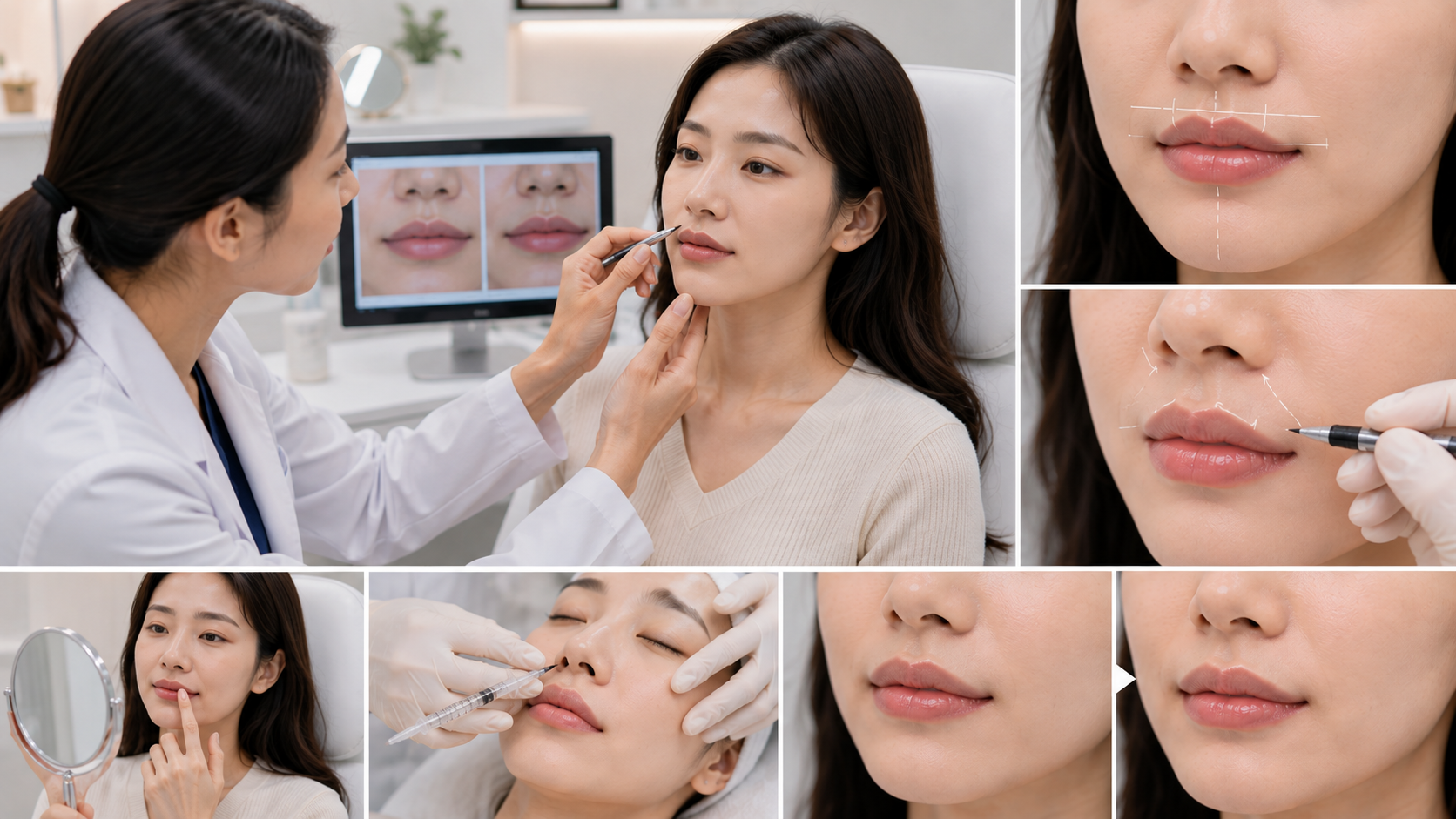
Lip and philtrum asymmetry correction is typically performed as an outpatient procedure, with the surgical plan and anesthesia approach adjusted to the degree and type of asymmetry being corrected; the exact plan is confirmed with the surgeon during consultation.
Stage | What Typically Happens |
|---|---|
Day 0 (Surgery Day) | Assessment of asymmetry direction and degree, marking of the treatment area, surgical correction performed through a subnasal or upper-lip-line incision, and careful wound closure |
Day 1-3 | Swelling and bruising are most noticeable during this early window; mild tightness around the mouth and nose is common |
Day 5-10 | Swelling and bruising gradually subside; many international patients remain in Korea through this window for early postoperative follow-up before flying home |
Week 4-8 | Proportional changes become clearer as residual swelling continues to resolve; 1-2 follow-up visits are typically scheduled during this period |
Month 12+ | Final lip and philtrum symmetry are generally considered stable and long-lasting, though natural aging and facial tissue changes can affect appearance over time |
The procedure generally follows a consistent pattern: the degree and direction of asymmetry are assessed by examining the upper and lower lips, the philtrum, and overall facial proportions, the desired correction is planned, and the surgical correction is carried out through whichever incision location — beneath the nose or along the upper-lip line — best addresses the specific asymmetry present. The incision is placed within a natural crease or the natural lip border so that any resulting scar is concealed as much as possible. Before surgery, patients are generally asked to disclose their full medical history, current medications, allergies, and any prior facial, lip, or philtrum procedures, including whether a previous injury or earlier surgery contributed to the current asymmetry, and to follow the surgeon's instructions on medications or supplements that can increase bleeding risk, along with guidance on smoking and alcohol.
During the initial recovery period, swelling, bruising, and mild tightness or stiffness around the mouth and nose are common, typically most noticeable in the first few days and improving steadily over the following one to two weeks. Aftercare commonly includes keeping the surgical area clean, following wound-care instructions, managing swelling as directed, maintaining appropriate oral hygiene, avoiding excessive pressure or exaggerated lip movement while healing, and attending the scheduled follow-up visits — usually one to two appointments during the stay in Korea. Initial proportional changes become visible once acute post-operative swelling resolves over the first one to two weeks, though the final, settled symmetry is only apparent once deeper tissue swelling and remodeling have fully resolved over the following weeks to months.
International patients evaluating this procedure in Seoul commonly weigh the accreditation of Korean clinics, the availability of language support, and how follow-up will be handled once they have returned home. Good-Line Plastic Surgery Clinic offers English-language consultation and an online contact channel. Because the appropriate length of stay depends on the specific type and degree of asymmetry being corrected, exact travel planning — including the earliest safe date to fly home — should always be confirmed directly with the surgeon rather than assumed from a general guideline.
Combining Lip and Philtrum Asymmetry Correction with Other Treatments
Because the philtrum sits directly beneath the nose, patients whose primary concern is philtrum-related asymmetry sometimes discuss this alongside rhinoplasty during the same consultation, since the two regions are anatomically adjacent and can influence each other's appearance.
Patients whose primary concern is added lip volume rather than corrected symmetry may instead be better served by Lip Augmentation, reviewed separately with the surgeon once the underlying asymmetry has been assessed.
Patients focused on broader facial balance rather than the lips or philtrum alone may also review the clinic's Facial Contouring Surgery page.
Whether to combine asymmetry correction with another procedure in a single session, or to stage treatments across separate visits, depends on the patient's overall health and the total anesthesia and recovery time involved, a consideration that matters in particular for international patients planning travel around a single trip to Seoul.
Patients are encouraged to raise their available time in Korea and any other procedures they are considering openly during consultation, since the appropriate combination plan is built around the individual case rather than offered as a fixed package.
Safety, Precision, and Clinic Standards
Good-Line Plastic Surgery Clinic is a Registered Medical Institution for Attracting Foreign Patients, certified by Korea's Ministry of Health and Welfare under the Medical Overseas Expansion and Foreign Patients Attraction Act. Dr. Choi deokho is a full member of the Korean Society of Plastic and Reconstructive Surgeons. Patient evaluation before surgery includes an individual examination of the degree and direction of asymmetry, review of medical history, and discussion of any prior injury or surgery that may have contributed to the current condition. As with any facial soft-tissue surgery, temporary swelling, bruising, discomfort, and residual asymmetry are possible, and less common risks can include infection, bleeding, scarring, wound-healing problems, changes in sensation, or persistent asymmetry that may require revision surgery — a consultation with the surgeon is required to review individual risk (see ASPS — Lip Augmentation).
Sterile surgical technique and individualized proportion planning are treated as baseline requirements rather than differentiators between clinics, and postoperative monitoring through scheduled follow-up visits is considered integral to the treatment plan rather than an optional courtesy. Because lip and philtrum tissue heals visibly and asymmetry-correction cases can involve prior scar tissue, patients are encouraged to raise any concerning symptom — unusual pain, spreading redness, fever, wound-healing problems, or unexpected asymmetric swelling — with the clinic promptly rather than waiting for the next scheduled appointment.
The Bottom Line
Lip and philtrum asymmetry correction addresses left-right imbalance in the lips or philtrum, not overall lip volume, through an incision placed beneath the nose or along the upper-lip line depending on the type of asymmetry.
The right incision location and technique depend on an individual assessment of where the asymmetry originates — the philtrum itself or the lip-line — not simply the procedure name a patient initially requests.
Reviewed and performed under Dr. Choi deokho, an experienced plastic surgeon with roughly 25 years at the clinic.
Swelling and bruising are most noticeable in the first few days and generally improve within about one to two weeks, with final symmetry settling over the following weeks to months.
Results are intended to be long-lasting and stable, though natural aging and facial tissue changes can affect appearance over time, and perfect symmetry cannot be guaranteed in every case.
Frequently Asked Questions
Who is a good candidate for lip and philtrum asymmetry correction? Good candidates are generally healthy adults with naturally asymmetrical lips or a crooked philtrum, or asymmetry that developed from a previous injury or inaccurate suturing, who have realistic expectations about achievable results. Final suitability, especially where a prior injury or surgery is involved, is confirmed at an individual consultation.
How is lip and philtrum asymmetry correction different from lip augmentation or lip reduction? Rather than adding or removing lip volume, asymmetry correction addresses unevenness between the left and right sides of the lips or philtrum, typically through an incision beneath the nose or along or under the upper-lip line. It is chosen when the primary concern is imbalance rather than lips being too thin or too full overall.
How is the incision location decided? The surgeon assesses whether the asymmetry originates primarily in the philtrum itself or in the lip line, and selects a subnasal incision, an upper-lip-line incision, or a combination of both accordingly. This decision is based on individual examination rather than a single standard technique applied to every patient.
Is lip and philtrum asymmetry correction painful, and what anesthesia is used? The procedure is planned individually, with the anesthesia approach confirmed with the surgeon based on the degree and type of correction needed. Post-operative soreness, tightness, or tenderness around the mouth and nose is common and is generally manageable with prescribed pain relievers.
What is the recovery timeline? Initial swelling and mild bruising typically peak within the first few days and gradually subside over the following one to two weeks, allowing most patients to resume normal daily routines while avoiding strenuous facial movement during that window. Final symmetry continues to settle over the following weeks to months.
Can asymmetry caused by a previous injury or earlier surgery be corrected? Yes — the clinic evaluates asymmetry that developed from a prior injury, trauma, or inaccurate suturing during an earlier lip or facial procedure as part of its assessment. Because existing scar tissue and altered anatomy factor into the surgical plan, these cases are reviewed individually rather than treated identically to naturally occurring asymmetry.
What are the risks and side effects of lip and philtrum asymmetry correction? Common temporary effects include localized swelling, mild bruising, tenderness, and stiffness around the mouth and nose. Less common risks can include infection, bleeding, scarring along the incision line, wound-healing problems, changes in sensation, or persistent asymmetry that may require revision surgery.
Is English-language support and online consultation available? Yes, Good-Line Plastic Surgery Clinic offers English-language support and an online consultation channel for international patients considering lip and philtrum asymmetry correction, alongside a multilingual clinic website.
How many follow-up visits are needed after surgery? Usually one to two follow-up visits are required during the stay in Korea for wound care or suture-related checks, and patients can maintain communication with the clinic through online channels if questions or concerns arise after returning home.
Book a Consultation at Good-Line Plastic Surgery Clinic
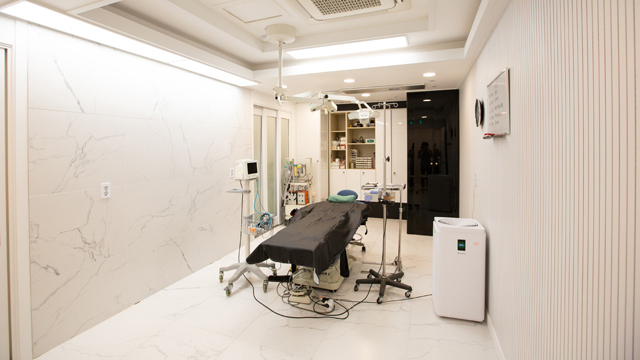
To discuss whether lip and philtrum asymmetry correction, and which incision approach, best fits your specific lip and philtrum anatomy, contact Good-Line Plastic Surgery Clinic in Gangnam-gu, Seoul at +82 2 543 1830 or through the clinic's online contact form. A consultation with Dr. Choi deokho is the only reliable way to determine which correction plan matches the direction and degree of your asymmetry.
Disclaimer
This page is for general informational purposes and does not constitute individualized medical advice. Candidacy, technique, and expected outcomes can only be determined through a consultation with a qualified physician.
Sources & Further Reading
Other Services
Explore additional treatments offered by our specialists.

Under-Eye Fat Repositioning
Under-eye fat repositioning is a transconjunctival lower-eyelid procedure that redistributes — rather than discards — the fat compartments beneath the eye, moving them around the orbital bone to correct hollowing and bulging caused by aging skeletal and.
Learn More

TRIPLE CELL
TRIPLE CELL is a non-invasive, radiofrequency-based skin treatment designed to deliver energy into different layers of the skin to support hydration, elasticity, and collagen-related skin recovery.
Learn More

Thermage Skin Tightening
Thermage Skin Tightening is a non-surgical radiofrequency treatment that heats targeted tissue beneath the skin to stimulate collagen remodeling, improving the appearance of mild-to-moderate skin laxity.
Learn More