Natural-Looking Face & Neck Lift Surgery and Personalized Anti-Aging Care in Apgujeong, Gangnam, Seoul
4.1 ★ Google · Board-Certified Plastic Surgeon
en-US

Lip Enhancement and Contouring · Consultation Required
Lip Augmentation
Lip augmentation is a volume-adding procedure that changes naturally small or thin lips into fuller, more voluminous lips through an injectable filler, autologous fat grafting, or a surgical technique, with the method chosen according to the patient's lip.
Schedule a Consultation
Lip Augmentation

Reviewer Details
Medically reviewed by Dr. Choi deokho, Representative Director & Plastic Surgeon, Good-Line Plastic Surgery Clinic.
Registered as the clinic's legal representative in the Korean National Tax Service registry, Full Member of the Korean Society of Plastic and Reconstructive Surgeons · Last reviewed 2026-08-18 · Good-Line Plastic Surgery Clinic, Gangnam-gu, Seoul.
Lip augmentation is a cosmetic procedure that increases lip volume, turning naturally small or thin lips into fuller, more voluminous lips proportioned to the rest of the face. At Good-Line Plastic Surgery Clinic in Gangnam-gu, Seoul, the procedure is planned individually around each patient's lip thickness, upper-to-lower lip proportion, and overall facial size. The technique and material selected — injectable, fat-based, or surgical — directly affect how long results last and what recovery involves.
What Is Lip Augmentation?
Lip augmentation is a volume-adding procedure that changes naturally small or thin lips into fuller, more voluminous lips through an injectable filler, autologous fat grafting, or a surgical technique, with the method chosen according to the patient's lip anatomy, facial proportions, and stated goals.
Increases volume in naturally small or thin lips rather than reshaping lips that are already full — for lips that are disproportionately full, lip reduction addresses the opposite concern.
Can be achieved through injectable dermal filler (commonly hyaluronic acid-based, temporary volume), autologous fat grafting (patient's own fat, no synthetic or donor material), or a surgical technique intended for a longer-term change.
Recovery and longevity depend on the specific technique and material chosen, since a temporary filler behaves differently in the tissue than a fat-grafting or surgical approach.
Good-Line Plastic Surgery Clinic references an average proportional guide of approximately 6-8mm for the upper lip and 10-12mm for the lower lip, adjusted individually to each patient's face.
Who Performs Lip Augmentation at Good-Line Plastic Surgery Clinic

Dr. Choi deokho
Representative Director and plastic surgeon
Dr. Choi deokho is the Representative Director and plastic surgeon at Good-Line Plastic Surgery Clinic, with approximately 25 years associated with the clinic since its establishment in 2001. His stated core specializations include facial plastic surgery, rhinoplasty, and facial contouring, and lip augmentation is evaluated within that same framework of overall facial harmony rather than as an isolated feature. He holds full membership in the Korean Society of Plastic and Reconstructive Surgeons, the Korean Society for Microsurgery, the Korean Cleft Palate-Craniofacial Association, the Japan Society of Aesthetic Plastic Surgery, the American Society of Aesthetic Plastic Surgery, and the International Society of Aesthetic Plastic Surgery. Before recommending a technique, Dr. Choi deokho evaluates lip size, thickness, shape, the proportion between the upper and lower lip, and how the patient's facial size relates to the outcome they are describing.
Because lip augmentation can be delivered through more than one technique and material, each with a different volume profile and expected longevity, Dr. Choi's evaluation places particular weight on matching the method to the patient's anatomy and expectations rather than defaulting to a single standard approach. A patient whose only concern is a short-term change before a specific event is evaluated differently from one seeking a longer-lasting, more permanent-feeling result, since the two goals point toward different techniques and materials.
Lip Augmentation Options Available
Injectable Lip Filler | Autologous Fat Grafting | Surgical Lip Augmentation |
|---|---|---|
Non-surgical injection of a dermal filler material, commonly hyaluronic acid-based | The patient's own fat is harvested and transferred into the lips | A surgical technique that adds and shapes lip volume directly |
Provides temporary volume; longevity depends on the specific product used | No synthetic or donor material introduced; intended to last longer than injectable filler | Planned for a longer-lasting or more permanent-feeling change in lip volume and shape |
Best for patients wanting to trial a change in volume before considering a longer-term option | Best for patients wanting longer-lasting volume without a synthetic or donor material | Best for patients seeking a defined, longer-term surgical change to lip shape and volume |
Lip augmentation is planned by evaluating lip size, thickness, shape, and the proportion between the upper and lower lip against the patient's overall facial proportions, since Good-Line Plastic Surgery Clinic notes that ideal lip thickness varies according to the size of the face and lips rather than following one universal target. Once the desired volume and shape are agreed, the selected technique and material are used, and symmetry and contour are checked before the patient leaves the treatment room. Because recovery and longevity depend on the specific technique and material selected, the surgeon's evaluation determines which approach is ultimately recommended.
Patients whose primary concern is volume are sometimes counseled on non-surgical lip filler as a comparison point, discussed on its own separate merits rather than as interchangeable with fat grafting or surgical augmentation. A filler material and a fat-grafting or surgical approach carry different follow-up schedules and timelines for the result to settle — considerations that matter for international patients planning their stay in Korea around the chosen method.
Who Is a Good Candidate for Lip Augmentation?
Healthy adults with naturally small or thin lips who want fuller, more voluminous lips and have realistic expectations about achievable results.
Patients whose desired lip proportions should be assessed in relation to their own facial features rather than one standard size applied to every patient.
Patients whose main concern is lip volume rather than lip shape or an irregular philtrum — those separate concerns are addressed through Lip and Philtrum Asymmetry Correction.
Patients open to discussing both temporary (injectable filler) and longer-lasting (fat grafting or surgical) options before deciding on a technique.
Not suitable candidates generally include those with active infection, certain uncontrolled medical conditions, or unrealistic expectations, until these issues are addressed; final suitability always requires individual clinical assessment.
What to Expect: Procedure, Recovery, and Results Timeline
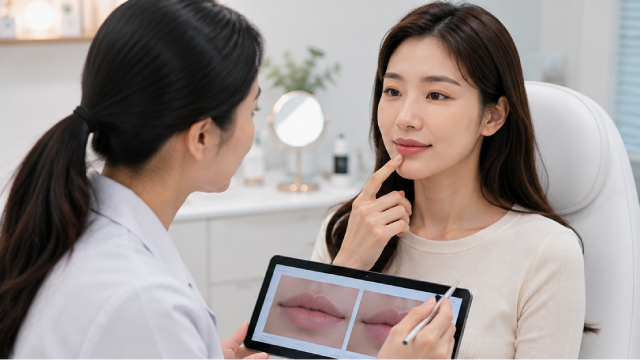
Lip augmentation is typically performed with local anesthesia, in some cases combined with sedation depending on the technique used; the exact plan is confirmed individually with the surgeon. Duration depends on the method used, but the consultation and procedure are generally completed within a single visit, with follow-up scheduled during the patient's stay in Korea.
Stage | What typically happens |
|---|---|
Day 0 | Lip size, thickness, and facial proportions confirmed; the selected augmentation technique and material are used to add volume, followed by a symmetry and contour check |
Day 1-3 | Swelling and mild bruising are most noticeable during this early window |
Day 5-10 | Initial swelling and bruising subside; most patients resume normal daily routines while avoiding excessive lip movement or pressure |
Week 4-8 | Proportional changes become clearer as residual swelling continues to resolve; follow-up visits are typically scheduled during this period |
Month 12+ | For temporary filler materials, longevity depends on the specific product and repeat treatment is generally expected over time; for fat grafting or surgical augmentation, results are intended to be longer-lasting, though natural aging and facial tissue changes can still affect appearance |
Before treatment, patients are generally asked to disclose their full medical history, current medications, allergies, and any previous facial or lip procedures, and to follow the surgeon's guidance on medications, smoking, and alcohol beforehand. Aftercare commonly includes keeping the treated area clean, following wound-care instructions where relevant, managing swelling as directed, maintaining oral hygiene, and avoiding excessive lip movement while healing, with usually one to two follow-up visits during the stay in Korea depending on the technique used.
Swelling, bruising, and mild tightness around the mouth are common, most noticeable in the first few days and improving over the following one to two weeks. Immediate proportional changes become visible once acute swelling resolves, though the final, settled contour is only apparent once deeper tissue swelling has fully subsided, and exact timelines vary between a filler-based approach and a fat-grafting or surgical approach.
International patients commonly weigh the accreditation of Korean clinics, language support, and how follow-up will be handled once they return home. Good-Line Plastic Surgery Clinic offers English-language consultation and an online contact channel for this purpose. Because the appropriate length of stay depends on the technique chosen, travel planning should always be confirmed directly with the surgeon rather than assumed from a general guideline.
Combining Lip Augmentation with Other Treatments
Lip augmentation may be combined with other facial aesthetic procedures when appropriate, assessed individually according to the patient's goals, anatomy, and overall health.
Patients whose primary concern is uneven lips or an irregular philtrum rather than overall volume may be better matched to Lip and Philtrum Asymmetry Correction, a separate procedure addressing a different underlying concern.
Patients focused on broader facial balance rather than lip volume alone may also review the clinic's Facial Contouring Surgery page.
Whether to trial a temporary filler before considering fat grafting or surgical augmentation is a decision made individually with the surgeon, since the approaches are discussed on their own separate merits.
Whether to combine lip augmentation with another procedure in a single session, or stage treatments across separate visits, depends on the patient's overall health and the total anesthesia and recovery time involved. Patients are encouraged to raise their available time in Korea and any other procedures under consideration openly during consultation, since the combination plan is built around the individual case rather than offered as a fixed package.
Safety, Precision, and Clinic Standards
Good-Line Plastic Surgery Clinic is a Registered Medical Institution for Attracting Foreign Patients, certified by Korea's Ministry of Health and Welfare under the Medical Overseas Expansion and Foreign Patients Attraction Act. Dr. Choi deokho is a full member of the Korean Society of Plastic and Reconstructive Surgeons. Before any procedure, patients are assessed individually for lip thickness, proportion, symmetry, and medical history. Temporary swelling, bruising, tenderness, and asymmetry are possible, and less common risks can include infection, bleeding, scarring, altered sensation, or over- and under-correction, with the specific risk profile depending on the technique and material used (see ASPS — Lip Augmentation).
Sterile technique and individualized proportion planning are treated as baseline requirements rather than differentiators between clinics, and postoperative monitoring through scheduled follow-up is considered integral to the treatment plan rather than an optional courtesy. Patients are encouraged to raise any concerning symptom — unusual pain, spreading redness, fever, or asymmetric swelling — with the clinic promptly rather than waiting for the next scheduled appointment.
The Bottom Line
Lip augmentation at Good-Line increases volume in naturally small or thin lips through injectable filler, autologous fat grafting, or a surgical technique, matched to the patient's goals.
The right method depends on an individual assessment of lip thickness, upper-to-lower lip proportion, and how long the patient wants the result to last — not simply the technique a patient initially requests.
Reviewed and performed under Dr. Choi deokho, an experienced plastic surgeon with roughly 25 years at the clinic.
Swelling and bruising are most noticeable in the first few days and generally ease within about one to two weeks, with final proportions settling over the following weeks.
Longevity varies by method: temporary filler materials generally require repeat treatment over time, while fat grafting and surgical augmentation are intended to be longer-lasting.
Frequently Asked Questions
Who is a good candidate for lip augmentation? Good candidates generally have naturally small or thin lips and want fuller, more voluminous lips in proportion to their face, with realistic expectations about achievable results. The best method is determined after evaluating lip thickness, proportion, and the patient's goals for how long the result should last.
Who should avoid or postpone lip augmentation? Lip augmentation is generally postponed for patients with an active infection, certain uncontrolled medical conditions, or other factors that make elective treatment unsafe, until these issues are addressed. Final suitability is always confirmed during an individual consultation.
What is the difference between lip filler, fat grafting, and surgical lip augmentation? Injectable lip filler, commonly hyaluronic acid-based, provides temporary volume and can be a way to trial a change before a longer-lasting option. Autologous fat grafting transfers the patient's own fat into the lips for longer-lasting volume without a synthetic or donor material, while surgical lip augmentation adds and shapes volume through a technique intended for a longer-term change; the recommended method depends on individual evaluation.
Is lip augmentation painful, and what anesthesia is used? Lip augmentation is typically performed with local anesthesia, in some cases combined with sedation depending on the technique used, so significant pain during the procedure itself is not expected. Post-treatment tenderness or mild swelling around the mouth is common and is generally manageable with care as directed by the clinic.
What is the recovery timeline for lip augmentation? Initial swelling and mild bruising typically peak within the first few days and gradually improve over the following one to two weeks, allowing most patients to resume normal routines while avoiding excessive lip movement. Final settling continues over the following weeks.
How long do lip augmentation results last? Longevity depends on the augmentation method and, if a temporary material is used, on the specific product. Injectable filler generally requires repeat treatment over time, while fat grafting and surgical augmentation are intended to be longer-lasting, though natural aging can still affect appearance over time.
What are the risks and side effects of lip augmentation? Common temporary effects include localized swelling, mild bruising, and tenderness. Less common risks can include infection, bleeding, scarring, changes in sensation, asymmetry, or over-correction or under-correction; the specific risk profile depends in part on which technique and material were used.
Is English support and online consultation available for lip augmentation? Yes, Good-Line Plastic Surgery Clinic offers English-language support and an online consultation channel for international patients considering lip augmentation, alongside a multilingual clinic website.
Book a Consultation at Good-Line Plastic Surgery Clinic

To discuss whether injectable filler, fat grafting, or surgical augmentation best fits your goals, contact Good-Line Plastic Surgery Clinic in Gangnam-gu, Seoul at +82 2 543 1830 or through the clinic's online contact form. A consultation with the surgeon is the only reliable way to determine which method matches your lip anatomy, facial proportions, and desired longevity of results.
Disclaimer
This page is for general informational purposes and does not constitute individualized medical advice. Candidacy, technique, and expected outcomes can only be determined through a consultation with a qualified physician.
Sources & Further Reading
Other Services
Explore additional treatments offered by our specialists.

Under-Eye Fat Repositioning
Under-eye fat repositioning is a transconjunctival lower-eyelid procedure that redistributes — rather than discards — the fat compartments beneath the eye, moving them around the orbital bone to correct hollowing and bulging caused by aging skeletal and.
Learn More

TRIPLE CELL
TRIPLE CELL is a non-invasive, radiofrequency-based skin treatment designed to deliver energy into different layers of the skin to support hydration, elasticity, and collagen-related skin recovery.
Learn More

Thermage Skin Tightening
Thermage Skin Tightening is a non-surgical radiofrequency treatment that heats targeted tissue beneath the skin to stimulate collagen remodeling, improving the appearance of mild-to-moderate skin laxity.
Learn More