Natural-Looking Face & Neck Lift Surgery and Personalized Anti-Aging Care in Apgujeong, Gangnam, Seoul
4.1 ★ Google · Board-Certified Plastic Surgeon
en-US

Eye Surgery · Consultation Required
Upper Blepharoplasty
Upper blepharoplasty is a surgical procedure that removes or repositions excess upper-eyelid skin and, where appropriate, underlying fat, to reduce a heavy or tired eyelid appearance and improve eyelid contour.
Schedule a Consultation
Upper Blepharoplasty

Reviewer Details
Medically reviewed by Dr. Choi deokho, Representative Director & Plastic Surgeon, Good-Line Plastic Surgery Clinic.
Registered as the clinic's legal representative in the Korean National Tax Service registry, Full Member of the Korean Society of Plastic and Reconstructive Surgeons · Last reviewed 2026-08-18 · Good-Line Plastic Surgery Clinic, Gangnam-gu, Seoul.
Upper blepharoplasty is a surgical procedure that removes or repositions excess upper-eyelid skin and, when appropriate, underlying fat, to improve eyelid contour and reduce the appearance of heaviness. At Good-Line Plastic Surgery Clinic in Seoul, the procedure is planned individually according to how much excess skin, fat, or muscle laxity is present in the upper lid.
What Is Upper Blepharoplasty?
Upper blepharoplasty is a surgical procedure that removes or repositions excess upper-eyelid skin and, where appropriate, underlying fat, to reduce a heavy or tired eyelid appearance and improve eyelid contour.
Performed through an incision placed along the natural upper-eyelid crease, so any resulting scar is concealed within the fold once healed.
Addresses excess upper-eyelid skin as the primary tissue of concern, with underlying fat removed or repositioned only when the surgeon's assessment indicates it is contributing to the heaviness.
Typically performed under local anesthesia, sometimes combined with sedation depending on the surgical plan and whether other procedures are performed at the same time.
Commonly takes around 1-2 hours, depending on the extent of correction required and whether it is combined with another eyelid or facial procedure.
Distinct from double eyelid surgery, which focuses on creating or defining a crease rather than removing excess tissue, although the two are sometimes performed together.
Who Performs Upper Blepharoplasty at Good-Line Plastic Surgery Clinic

Dr. Choi deokho
Representative Director and plastic surgeon
Dr. Choi deokho is the Representative Director and plastic surgeon at Good-Line Plastic Surgery Clinic, with approximately 25 years associated with the clinic since its establishment in 2001. His stated core specializations include facial plastic surgery with a specific focus on eye surgery and eye revision, alongside rhinoplasty and facial contouring, and he holds full membership in the Korean Society of Plastic and Reconstructive Surgeons, the Korean Society for Microsurgery, the Korean Cleft Palate-Craniofacial Association, the Japan Society of Aesthetic Plastic Surgery, the American Society of Aesthetic Plastic Surgery, and the International Society of Aesthetic Plastic Surgery. Every upper blepharoplasty consultation at the clinic begins with an examination of eyelid skin quantity, fat volume, muscle tone, and brow position, since these characteristics determine both the surgical plan and how much correction is realistic.
Because a heavy or tired-looking upper eyelid can stem from several different underlying causes — excess skin alone, excess skin combined with fat fullness, or eyelid heaviness that is actually related to eyebrow position or age-related drooping (ptosis) rather than skin excess — Dr. Choi's evaluation places particular weight on identifying which of these is actually driving the patient's concern before recommending upper blepharoplasty as the solution. A patient whose main issue is a drooping brow may be better served by a brow-focused approach than by eyelid skin removal alone, and a patient whose eyelid margin itself is drooping (true ptosis) needs eyelid ptosis correction rather than, or in addition to, upper blepharoplasty. This distinction is treated as a core part of the surgical planning process rather than a formality before booking a standard procedure.
Upper Blepharoplasty Options Available
Skin-Only Excision | Skin + Fat Excision/Repositioning | Combined with Double-Eyelid Crease Creation |
|---|---|---|
Removes excess upper-eyelid skin only, along the natural crease line | Removes excess skin and addresses underlying fat that is contributing to eyelid fullness or heaviness | Combines excess-skin removal with creation or refinement of the upper-eyelid crease in the same session |
Best for patients whose primary concern is loose or overhanging skin, with little underlying fat fullness | Best for patients whose eyelid appears heavy or puffy in addition to having excess skin | Best for patients who want both a more defined crease and correction of excess skin at the same time |
Generally the more limited of the three approaches in terms of tissue addressed | Allows more complete correction of eyelid contour when fat is a contributing factor | Addresses two separate concerns — skin excess and crease definition — in a single procedure |
Which of these three approaches is appropriate depends on an individual examination of eyelid skin quantity, fat volume, and existing crease characteristics — not a single default technique applied to every patient. Beyond upper blepharoplasty itself, the clinic separately evaluates whether eyelid heaviness is being driven by factors outside the eyelid skin and fat, such as brow position or upper-eyelid ptosis (drooping related to the levator muscle or tendon rather than skin excess); when ptosis is the primary driver, eyelid ptosis correction may be recommended instead of, or alongside, upper blepharoplasty. Not every case of eyelid heaviness requires the full skin-and-fat approach — for patients with excess skin but minimal fat fullness, a more conservative skin-only excision can achieve a refreshed appearance while limiting the extent of tissue removed. Choosing between these options is not simply a matter of patient preference: skin elasticity, fat volume, and crease position meaningfully affect which approach will produce a durable, natural-looking result, which is why the surgeon's physical examination — rather than a menu selection — determines the recommended technique.
Who Is a Good Candidate for Upper Blepharoplasty?
Adults with excess upper-eyelid skin, eyelid fullness, or age-related upper-eyelid changes who are generally healthy and have realistic expectations about the outcome.
Patients whose upper eyelid appears heavy or tired due to excess skin, with or without accompanying fat fullness, rather than primarily due to eyebrow position or true ptosis.
Patients seeking a more refreshed eyelid contour who understand that results depend on individual anatomy and healing.
Generally not suitable, or requiring postponement, for patients with uncontrolled medical conditions, active eye or eyelid infection, significant untreated eye problems, or pregnancy.
Patients whose expectations cannot realistically be achieved by removing or repositioning eyelid skin and fat alone — for example, those whose primary concern is brow drooping or true eyelid ptosis — should discuss the distinction candidly with the surgeon before proceeding.
What to Expect: Procedure, Recovery, and Results Timeline
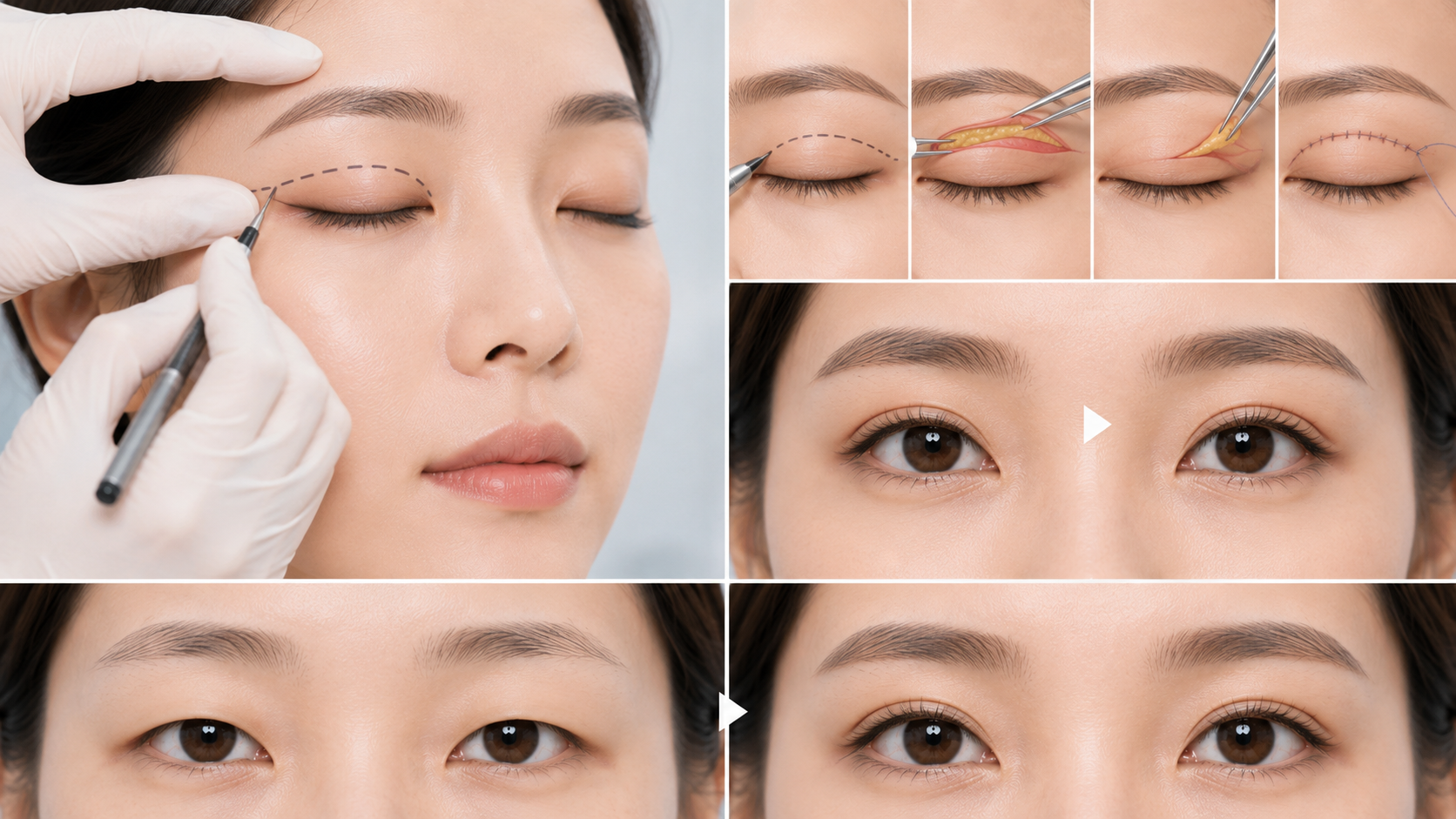
Before surgery, patients are evaluated through a review of eyelid skin, fat, eyelid position, and asymmetry, along with a complete medical and eye history, disclosure of all medications and supplements, and instructions regarding eating, drinking, and any medication adjustments. During surgery, the surgeon marks the planned incision, administers anesthesia, makes an incision along the natural upper-eyelid crease, removes or repositions the appropriate tissue, and closes the incision.
Stage | What typically happens |
|---|---|
Day 0 | Local anesthesia, sometimes combined with sedation; incision made along the natural upper-eyelid crease; tissue removed or repositioned and incision closed |
Day 1-3 | Swelling and bruising are most noticeable during this period |
Day 5-10 | Swelling and bruising gradually improve; many patients feel comfortable resuming routine activity within this window |
Week 4-8 | Residual swelling and scar maturation continue to settle; eyelid contour becomes progressively clearer |
Month 12+ | Final result generally assessed once tissue has fully settled and healing is complete; results can be long-lasting, although natural aging continues afterward |
International patients commonly plan to allow approximately 7-10 days in Korea to accommodate the surgery, early follow-up, and, where applicable, suture removal, though the exact schedule should be confirmed individually with the surgeon rather than assumed from a general guideline. Flying home is generally considered appropriate only once the surgeon has confirmed that early healing is progressing normally, which for uncomplicated eyelid surgery is often around 7 days after the procedure, though this depends on individual healing. Aftercare commonly includes prescribed wound and eye care, keeping the treated area clean, following activity restrictions as instructed, and attending scheduled follow-up visits so that healing can be monitored and any concern addressed promptly.
Combining Upper Blepharoplasty with Other Treatments
Upper blepharoplasty may be combined with double eyelid surgery in the same session for patients who want both excess-skin removal and crease creation or refinement addressed together.
Upper blepharoplasty may be combined with eyelid ptosis correction when a patient's evaluation shows both excess eyelid skin and levator-related drooping contributing to the overall appearance.
Upper blepharoplasty may also be combined with a brow lift or with Lower Blepharoplasty when the patient's evaluation shows that eyebrow position or under-eye fat and skin are also contributing to the overall appearance of the eye area.
Whether any combination is appropriate depends on the patient's individual anatomy, overall health, and the total anesthesia and recovery time involved, and is determined during consultation rather than offered as a standard package for every patient.
Safety, Precision, and Clinic Standards
Good-Line Plastic Surgery Clinic is a Registered Medical Institution for Attracting Foreign Patients, certified by Korea's Ministry of Health and Welfare under the Medical Overseas Expansion and Foreign Patients Attraction Act. Dr. Choi deokho is a full member of the Korean Society of Plastic and Reconstructive Surgeons. Patient assessment before upper blepharoplasty includes a review of eyelid skin, fat, eyelid position, and asymmetry, along with a complete medical and eye history. Risk reduction generally involves appropriate preoperative assessment, careful surgical planning, sterile surgical technique, appropriate tissue removal, and postoperative monitoring. As with any eyelid surgery, temporary swelling, bruising, asymmetry, dry or irritated eyes, and scarring are possible, and uncommon complications can affect eyelid position or vision — a consultation with the surgeon is required to review individual risk (see ASPS Eyelid Surgery Safety). Scheduled follow-up monitoring is treated as a baseline part of postoperative risk reduction rather than an optional courtesy, since a missed follow-up visit can delay identification of a complication that would otherwise be manageable if caught early. Patients are encouraged to raise any concerning symptom — unusual pain, vision changes, or asymmetric swelling — with the clinic promptly rather than waiting for the next scheduled appointment.
The Bottom Line
Upper blepharoplasty removes or repositions excess upper-eyelid skin and, when appropriate, underlying fat, to reduce heaviness and improve eyelid contour.
Three approaches are available — skin-only excision, skin plus fat excision/repositioning, and combination with double-eyelid crease creation — chosen according to individual eyelid skin, fat, and crease characteristics.
Reviewed and performed under Dr. Choi deokho, a board-registered, experienced plastic surgeon with roughly 25 years at the clinic.
Swelling and bruising are most noticeable in the first several days and generally improve substantially within 1-2 weeks, while the final eyelid contour settles over several months.
Results are considered long-lasting, though natural aging continues afterward, and upper blepharoplasty does not halt the aging process for the surrounding eye area or face.
Frequently Asked Questions
What does upper blepharoplasty actually remove? Upper blepharoplasty removes excess upper-eyelid skin and, when the surgeon's assessment indicates it is contributing to heaviness, underlying fat as well. Whether fat is addressed, and how much skin is removed, depends on an individual examination rather than a fixed formula.
How is upper blepharoplasty different from double eyelid surgery? Upper blepharoplasty focuses on removing excess eyelid skin and fat to reduce heaviness, while double eyelid surgery focuses on creating or defining the upper-eyelid crease itself. Some patients need only one procedure, while others benefit from having both performed together, which is determined at consultation.
Is upper blepharoplasty painful? Local anesthesia, sometimes combined with sedation, is used during the procedure itself, so significant pain during surgery is not expected. Afterward, swelling, tightness, and mild tenderness are common during early recovery and are generally manageable with prescribed medication and cold compresses.
How long does upper blepharoplasty take? Upper blepharoplasty commonly takes around 1-2 hours, depending on the extent of correction required and whether it is combined with another procedure in the same session.
Will upper blepharoplasty leave a visible scar? The incision is placed along the natural upper-eyelid crease specifically so that any resulting scar is concealed within the fold once healing is complete.
How long does recovery from upper blepharoplasty take? Swelling and bruising are most noticeable during the first several days and generally improve substantially over the following 1-2 weeks, allowing most patients to resume routine activity. Residual swelling and scar maturation can continue for several weeks, with the final eyelid contour assessed once tissue has fully settled, often several months after surgery.
Can upper blepharoplasty be combined with other eyelid or facial procedures? Yes — upper blepharoplasty may be combined with double eyelid surgery, eyelid ptosis correction, a brow lift, or lower blepharoplasty when a patient's evaluation shows that more than one area is contributing to the overall appearance. Whether combination is appropriate is assessed individually rather than offered as a standard package.
How many days should I plan to stay in Korea for upper blepharoplasty? International patients commonly plan to allow approximately 7-10 days for the surgery, early follow-up, and, where applicable, suture removal, though this should be confirmed individually with the clinic based on the specific surgical plan.
Is English-language consultation available for upper blepharoplasty? Yes, Good-Line Plastic Surgery Clinic offers English-language support and an online consultation channel for international patients considering upper blepharoplasty.
Book a Consultation at Good-Line Plastic Surgery Clinic

To discuss whether upper blepharoplasty, or a combination with double eyelid surgery, ptosis correction, or a brow lift, is right for you, contact Good-Line Plastic Surgery Clinic in Gangnam-gu, Seoul at +82 2 543 1830 or through the clinic's online contact form. A consultation is the only reliable way to determine which approach fits your specific eyelid anatomy and aesthetic goals.
Disclaimer
This page is for general informational purposes and does not constitute individualized medical advice. Candidacy, technique, and expected outcomes can only be determined through a consultation with a qualified physician.
Sources & Further Reading
Other Services
Explore additional treatments offered by our specialists.

Under-Eye Fat Repositioning
Under-eye fat repositioning is a transconjunctival lower-eyelid procedure that redistributes — rather than discards — the fat compartments beneath the eye, moving them around the orbital bone to correct hollowing and bulging caused by aging skeletal and.
Learn More

TRIPLE CELL
TRIPLE CELL is a non-invasive, radiofrequency-based skin treatment designed to deliver energy into different layers of the skin to support hydration, elasticity, and collagen-related skin recovery.
Learn More

Thermage Skin Tightening
Thermage Skin Tightening is a non-surgical radiofrequency treatment that heats targeted tissue beneath the skin to stimulate collagen remodeling, improving the appearance of mild-to-moderate skin laxity.
Learn More