Natural-Looking Face & Neck Lift Surgery and Personalized Anti-Aging Care in Apgujeong, Gangnam, Seoul
4.1 ★ Google · Board-Certified Plastic Surgeon
en-US

Medical Guide
Anesthesia Options for Plastic Surgery in Korea: A Guide
Awake, sedated or asleep is decided by the extent of the operation, not by the procedure's name — which is why the answer arrives later than patients expect.
Schedule a Consultation
Anesthesia Options for Plastic Surgery in Korea: A Guide
Medically reviewed by Dr. Choi Deokho, Representative Director, Goodline Plastic Surgery
Patients ask what the procedure involves and rarely ask what they will be during it. The second question turns out to govern more of the day than the first: whether you eat breakfast, whether somebody has to collect you, how long you are in the building, and how much of it you will remember.
Reading across Goodline Plastic Surgery's descriptions of its treatments, a pattern emerges that is worth setting out plainly, along with the part of it that is genuinely unresolved until somebody examines you.
Four tiers, and what sits in each
The clinic's material describes four levels across its range of treatments.
Nothing, or comfort measures only. Thermage is described as generally performed without surgical anesthesia, with comfort measures depending on the patient's needs and clinic protocol. Non-invasive skin treatments are described similarly, with cooling or other comfort measures according to device and protocol. Non-surgical lifting treatments are described as commonly requiring no general anesthesia, with topical or other comfort measures considered depending on the procedure.
Topical numbing. Secret RF microneedling is described with numbing cream commonly applied beforehand. Filler rhinoplasty is described with local or topical numbing, and the clinic states that general anesthesia is generally unnecessary for it. Non-surgical injectable contouring is described with topical anesthetic cream or local anesthetic where appropriate. Thread lifting is described with local or topical anesthesia, depending on the treatment area, the number of threads and the individual plan.
Local anesthesia, sometimes with sedation. This is the eyelid tier. Double eyelid surgery, revision eyelid surgery, ptosis correction, upper blepharoplasty, lower blepharoplasty and under-eye fat repositioning are all described this way, with the exact method confirmed with the surgeon and depending on the procedure and the patient.
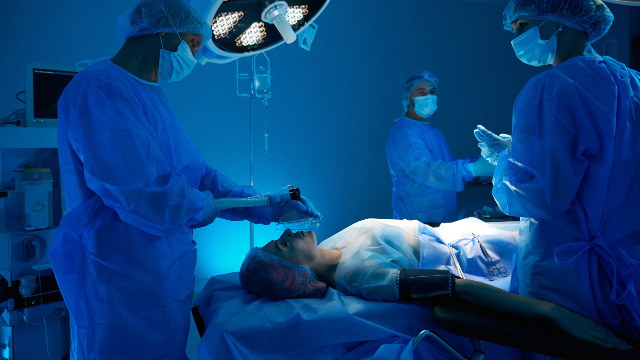
General anesthesia, or deep sedation with local. Breast implant surgery is described as usually performed under general anesthesia. A facelift is described as commonly performed under general anesthesia or monitored or deep sedation with local anesthesia, depending on the procedure and the surgeon.
Between the third and fourth tiers sits a group whose answer is explicitly conditional, and that group is larger than either fixed tier.
The conditional group, and why it matters
For rhinoplasty the clinic describes either local anesthesia with sedation or general anesthesia, depending on technique, extent and the patient's condition. For revision rhinoplasty it names general anesthesia first, with local anesthesia and intravenous sedation possible in some cases, determined by the surgeon and the anesthesia team.
For chin augmentation it describes local with sedation or general depending on technique. For surgical forehead contouring the same, with non-surgical treatment requiring little or no anesthesia. For neck wrinkle removal surgery the same, depending on the surgical plan. For abdominal liposuction it describes local with sedation as appropriate for some procedures and general for larger or combined ones, with the method determined during the preoperative assessment. For the Y-Zone liposuction and lift procedure, the same conditional phrasing, depending on the extent of treatment. For hand fat grafting it describes a range from local with sedation for minor cases through to general for more extensive ones.
The repeated word across all of these is extent. Not the procedure's name, not its reputation, not where it sits on a treatment menu — how much is being done.
This has a consequence that frustrates people and should not. If you ask, before your plan exists, whether you will be asleep, the honest answer is that nobody knows yet. The anesthesia decision follows the surgical plan, and the surgical plan follows the examination. A clinic that answers that question confidently at the enquiry stage is answering a question it has not yet been given the information for.
What actually changes for you, by tier
This is the part worth planning around, because each tier carries a different day.
With comfort measures or topical numbing, the appointment is an appointment. You arrive, possibly early to let numbing cream work, and you leave. No fasting, no escort, no recovery period in the building beyond a short observation.
With local anesthesia, you are awake and aware. You will hear the room. For eyelid work this is standard and most people manage it without difficulty, but it is worth knowing in advance rather than discovering on the table, particularly if you are anxious in medical settings. Tell the clinic beforehand if you are; it affects what they offer.
With sedation, you are drowsy to deeply drowsy and your memory of the procedure may be partial or absent. Fasting instructions apply. Somebody should collect you. You should not make decisions, sign documents or travel alone for the rest of the day.
With general anesthesia, you are unconscious and your breathing is managed. Fasting instructions are strict, preoperative assessment is more involved, recovery in the building is longer, and the escort requirement is not negotiable.
MedlinePlus's overview of anesthesia covers the categories in general terms, and its page on surgery sets out what preoperative preparation usually involves.
The complication that appears on the risk lists
Across several of the clinic's procedure descriptions, complications related to anesthesia appear as a named risk — for abdominal liposuction, for the Y-Zone procedure, and for revision rhinoplasty among others. For facelift surgery the clinic names anesthesia monitoring specifically among the measures that reduce risk, and for revision rhinoplasty it names qualified surgical and anesthesia care.
This is the reason the escalation from local to general is not merely a comfort upgrade. Each tier adds something to be managed, and the clinic's own risk-reduction language tracks that: monitoring and qualified anesthesia care appear where general anesthesia is most likely, and not where numbing cream is the whole of it.
It is also why the preoperative questions below matter more than their brevity suggests.
Questions worth asking, in order
Which anesthesia is planned for my procedure, and what would change it? The second half of that question is the useful half, given how often the clinic's descriptions make the answer conditional on extent.
Who administers and monitors it? A name or a role is an answer. For general anesthesia, ask specifically who is monitoring you during the operation, because that is a different person from the one operating.
What are my fasting instructions, and from when? Measured in hours before the procedure, in local time. Getting this wrong is the most common reason an operation is postponed on the day, and a postponement on a short trip may mean no operation at all.
What about my regular medication on the morning? Some medication is taken with a sip of water despite fasting; some is held. Do not decide this yourself. The clinic's own preparation guidance across procedures says plainly not to stop prescribed medication without medical advice.
Do I need somebody to collect me? For anything above topical numbing, assume yes until told otherwise, and remember that a hotel is not an escort.
Have I disclosed everything relevant? Previous reactions to anesthesia, family history of anesthesia problems, sleep apnea, reflux, loose teeth, heart or lung conditions, and all medications and supplements including ones you consider trivial. MedlinePlus's note on dietary supplements is a reasonable reminder of why the last category is not trivial.
Published results are collected in the before-and-after gallery, and consultations are arranged through contact.

Traveling for surgery adds two wrinkles
Both are easy to miss.
Jet lag and fasting interact badly. If you have crossed many time zones, your body's sense of when it last ate is not aligned with the clock the instructions use. Follow the clock, not the feeling, and say if you are unsure about what counts.
Your medical history is not in the building. At home, some of what matters is already on file. Abroad, everything the anesthesia decision depends on arrives through you. Bringing a written list — conditions, medications with doses, allergies, previous anesthesia and any problems with it — is a ten-minute task that removes a category of risk. MedlinePlus explains the general idea under personal health records.
A note on the word "sedation"
It covers a wide range, and the range is the source of most misunderstanding.
The clinic's descriptions use several forms: local anesthesia with sedation, local anesthesia with intravenous sedation, and monitored or deep sedation with local anesthesia for facelift surgery. Those are not identical experiences. Light sedation leaves you drowsy but rousable and aware of the room; deep sedation is much closer to general anesthesia in how it feels and in what it requires.
So "you will be sedated" is not a complete answer. The follow-up question — will I be aware, and will I remember — is short, reasonable, and gets you the information the first answer left out.
Frequently Asked Questions
Will I be asleep for eyelid surgery?
The clinic describes local anesthesia as commonly used for eyelid procedures, sometimes with sedation, with the exact method confirmed with the surgeon. That means awake or drowsy rather than unconscious, in most cases.
What about rhinoplasty?
It is described as either local anesthesia with sedation or general anesthesia, depending on the surgical technique, the extent of surgery and the patient's condition. For revision cases the clinic names general anesthesia first.
Which procedures use general anesthesia?
Breast implant surgery is described as usually performed under general anesthesia, and facelift surgery as commonly under general anesthesia or monitored or deep sedation with local. Several other procedures may use it depending on extent.
Why can't the clinic tell me in advance?
Because the decision follows the surgical plan and the plan follows examination. The clinic's descriptions repeatedly condition the answer on the extent of treatment, which is not known until the assessment is done.
Do I need to fast?
For sedation and general anesthesia, yes, and the instructions are specific to you and your schedule. For topical numbing and comfort measures, generally not. Ask for the instruction in hours and in local time.
Do I need someone to collect me?
Assume so for anything beyond topical numbing, and confirm with the clinic. Sedation affects judgment and memory for longer than people expect.
Is anesthesia a listed risk?
Complications related to anesthesia appear on several of the clinic's procedure risk lists, and anesthesia monitoring and qualified anesthesia care appear among the measures it names for reducing risk.
What should I disclose beforehand?
Previous anesthesia and any problems with it, family history of anesthesia problems, all medications and supplements, allergies, and any heart, lung or sleep-related conditions. Do not stop prescribed medication on your own initiative.
The Bottom Line
- The clinic's material describes four levels: comfort measures only, topical numbing, local anesthesia with or without sedation, and general anesthesia or deep sedation with local.
- Eyelid procedures sit consistently in the local tier; breast implant surgery is described as usually general; facelift surgery as general or deep sedation with local.
- A large middle group — rhinoplasty, chin augmentation, forehead contouring, neck surgery, liposuction, fat grafting — is explicitly conditional, with the recurring determinant being the extent of treatment.
- That is why a firm answer before assessment is not available, and a confident one offered too early should be treated with caution.
- The practical consequences differ by tier: fasting, an escort, longer time in the building and more involved preoperative assessment all arrive with sedation and general anesthesia.
This article is for general informational purposes and does not constitute individualized medical advice. It is not a self-diagnosis tool. Nothing here can establish which anesthesia is appropriate for you or whether you are fit for it. Only a qualified plastic surgeon and anesthesia clinician who have assessed you can determine that, and any breathing difficulty, chest pain or severe reaction after a procedure should be treated as an emergency where you are.
References
- MedlinePlus — Anesthesia
- MedlinePlus — Surgery
- MedlinePlus — After Surgery
- MedlinePlus — Pain Relievers
- MedlinePlus — Drug Safety
- MedlinePlus — Dietary Supplements
- MedlinePlus — Personal Health Records
- MedlinePlus — Sleep Apnea
- MedlinePlus — Talking With Your Doctor
More Articles
Continue reading our clinical guides.

Revision Rhinoplasty in Seoul: What US Patients Should Know
Revision rhinoplasty in Seoul for US patients: why secondary nose surgery is harder, what recovery looks like, honest expectations, and Goodline's plan.
Learn More
Rejuran vs RE20 vs Juvelook Volume: Skin Boosters Compared
Three injectables that look alike on a clinic menu and solve three unrelated problems. Hydration, repair and volume differ in timeline and in results.
Learn More

Primary vs Revision Rhinoplasty: The Differences That Matter
A second nose operation is not the first one repeated. Scar tissue, longer operating time and a result that takes a year change what you should expect.
Learn More