Natural-Looking Face & Neck Lift Surgery and Personalized Anti-Aging Care in Apgujeong, Gangnam, Seoul
4.1 ★ Google · Board-Certified Plastic Surgeon
en-US

Medical Guide
Breast Augmentation Cost: Seoul vs US Implant Surgery
Breast augmentation cost in Korea vs the US: published ASPS fee ranges, how Goodline's endoscopic implant technique differs, and the FDA risks to weigh.
Schedule a Consultation
Breast Augmentation in Seoul vs the US: Technique and Cost Compared
Medically reviewed by Dr. Choi Deokho, Board-Certified Plastic Surgeon, Representative Director, Goodline Plastic Surgery
Comparing breast augmentation cost in Korea against a US quote means comparing two things that are often priced differently and, in some cases, performed differently. The United States has published fee data you can check; Seoul clinics generally quote per case after an examination. This article sets out what the published US figures actually cover, how the technique documented at one Seoul clinic differs from conventional implant surgery, and which safety facts belong in the decision alongside price.
To be clear from the start: Goodline Plastic Surgery in Gangnam, Seoul, does not publish a price for breast augmentation, and no price is estimated here. The clinic's documentation records that prices are confirmed at consultation. What can be compared honestly is technique, process, and the structure of the two cost models.
What US Breast Augmentation Costs, According to Published Data
The American Society of Plastic Surgeons (ASPS) publishes annual average surgeon fees. For 2024, ASPS reported:
- Breast augmentation (implant placement, primary and/or revision): $4,575 to $8,000
- Breast augmentation with fat grafting only (no implants): $5,500 to $9,500
- Breast implant removal (augmentation patients only): $3,650 to $6,500
- Breast lift (mastopexy): $6,500 to $11,000
These are surgeon or physician fees only. ASPS states that anesthesia, operating room facilities, and other related expenses are not included, and that the counts reflect procedures performed by ASPS member surgeons. The organisation also moved in 2024 from publishing a single average to publishing a range, explaining that a range better reflects the diverse geographic locations and practice settings of its members. That is why the same operation is quoted differently in different US cities.
Two of those lines deserve attention when planning. Implant removal and breast lift are listed separately because they are separate operations. Implants are not lifetime devices, and the FDA advises that patients with breast implants may need additional surgery over their lifetime. A cost comparison that only prices the first operation is incomplete.
Fat Grafting Is Not the Cheaper Option
A common assumption is that an implant-free approach costs less. The published US data points the other way: ASPS reported a higher 2024 surgeon fee range for breast augmentation with fat grafting only ($5,500 to $9,500) than for implant placement ($4,575 to $8,000).
The reason is that fat grafting is two procedures in one. Fat must be harvested by liposuction from a donor area, processed, and then injected, which takes longer and requires the patient to have sufficient donor fat. The volume increase achievable in a single session is also more limited than with an implant, and some grafted fat is reabsorbed. Neither approach is universally better. They answer different goals, and candidacy differs.
How Goodline's Documented Technique Differs
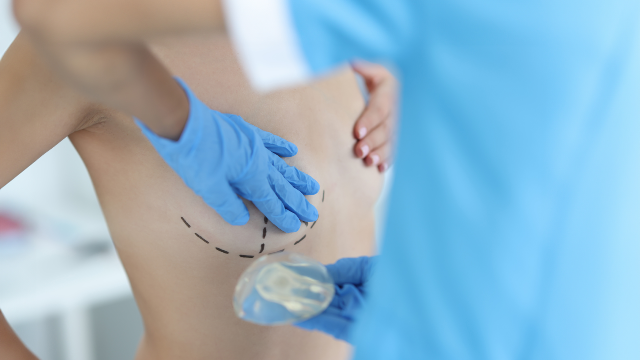
Goodline's documentation describes an endoscopic approach to breast augmentation using cohesive gel implants. Several elements distinguish it from a conventional implant operation, and each is stated by the clinic rather than inferred here.
- The surgical space is created under endoscopic visualisation, which the clinic states allows the surgeon to identify tissue layers and control bleeding during dissection.
- A patented implant-insertion apparatus is used. The clinic states this apparatus can insert a cohesive gel implant through an incision approximately 60 percent the length of a conventional incision, that insertion takes about five seconds, and that the device is designed to reduce pressure and physical impact on the incision.
- The operation is performed under sedation anesthesia rather than general anesthesia, using local anesthetics with hydrodissection. The clinic attributes this approach to reduced tissue injury and bleeding.
- A narrow electrocautery device is used during dissection.
The anesthesia point is worth isolating, because breast implant surgery in the United States is usually performed under general anesthesia. Anesthesia type affects both the clinical experience and the anesthesia line on a US invoice, so it is one of the reasons two quotes are not directly comparable.
What the clinic states about these techniques is that they are intended to reduce incision length and minimise tissue injury and bleeding. That is a description of design intent. It is not a claim of a lower complication rate, and it should not be read as one. Outcomes vary according to anatomy, implant selection, surgical technique, healing, and other individual factors.
The Stem Cell Center and What the Documentation Actually Says
Goodline operates five dedicated centers: Facial Contouring, Body Line, Stem Cell, Anti-Aging, and Skin Care. The clinic's documentation describes the Stem Cell Center as offering breast augmentation and fat grafting, and lists it among the clinic's distinguishing features.
Precision matters here. The clinic's detailed breast augmentation procedure documentation describes the endoscopic, cohesive-gel-implant technique set out above. It separately documents autologous fat transplantation as an option for breast augmentation after childbirth, and breast lifting where the primary concern is sagging. Where sagging is significant, the documentation states that augmentation and lifting can be combined when lifting alone is unlikely to give a satisfactory result.
Anything beyond that — a specific stem cell protocol, cell processing method, or comparative outcome data — is not something this article can responsibly describe, because the clinic's documentation does not set it out. If a stem-cell-based approach is what interests you, that is a question for a consultation, where the clinic can explain what it actually offers for your case.
The Safety Facts That Should Sit Beside the Price
The FDA maintains public information on breast implants that applies regardless of where surgery is performed. Anyone comparing prices should read it first.
- Known risks include infection, bleeding, asymmetry, changes in nipple or breast sensation, implant displacement, rippling or visibility, rupture or deflation, capsular contracture, and scarring.
- Additional surgery may be needed over time. Implants are not permanent devices.
- Breast implant-associated anaplastic large cell lymphoma (BIA-ALCL) has been reported. It is not breast cancer but a lymphoma, usually found in the scar tissue and fluid around the implant. The FDA describes individual risk as low, but the condition is serious and can be fatal if not treated promptly. Risk is higher with textured-surface implants than smooth-surface implants.
- The main symptoms of BIA-ALCL are persistent swelling, a mass, or pain around the implant, often appearing years after the incision has healed.
Goodline's own documentation lists a comparable set of risks, including capsular contracture, implant rupture or leakage, the possibility of revision surgery, and rare implant-associated cancers such as BIA-ALCL. It also documents that the procedure may need to be postponed or avoided in patients with untreated breast disease, active infection, uncontrolled medical conditions, or pregnancy, and that final suitability requires medical evaluation.
For a patient travelling abroad, the practical implication is about follow-up rather than the operation itself. BIA-ALCL symptoms can appear years later, and implant surveillance is a long-term commitment. Establish before you travel who will monitor you at home.
What the Process Looks Like at Goodline
The clinic documents a defined sequence, which is useful when comparing what a quote includes.
- Assess breast shape, size, chest proportions, and degree of sagging.
- Discuss the desired size and select an implant.
- Prepare the surgical area and anesthesia.
- Create the surgical space under endoscopic visualisation.
- Control bleeding during tissue dissection.
- Insert the cohesive gel implant using the clinic's patented insertion apparatus.
- Close the incision and apply postoperative dressing and pressure support.
Implant size is selected after consultation, taking into account height, bust size, chest shape, breast length and shape, degree of sagging, body composition, age, weight, childbirth history, nipple and breast position, and the patient's preferences. The clinic states that blood testing and X-ray testing should be performed before surgery.
Documented preparation includes avoiding surgery during menstruation where possible, treating a significant cold or aches beforehand, stopping smoking and alcohol roughly one to two weeks before surgery, and discussing medications and supplements such as aspirin, vitamin E, and herbal preparations because they can affect bleeding or recovery. Where general anesthesia is used, the documentation states patients should fast for more than eight hours.
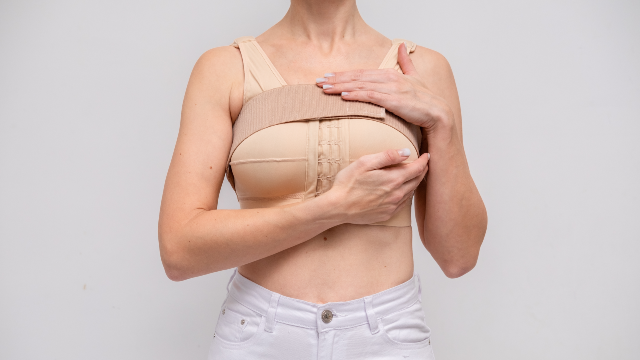
Aftercare is documented as a blood drainage pocket to prevent blood accumulation, a pressure bandage to reduce swelling and help stabilise the implant, and functional underwear after approximately two to three days. Follow-up is the next day, with roughly two to three outpatient visits until stitches are removed around seven to nine days after surgery. Excessive pressure on the breasts, alcohol, smoking, and strenuous exercise are to be avoided.
Recovery Timing and What It Costs in Days
Goodline documents that the operation generally takes approximately one to two hours. Some pain may occur immediately afterwards but generally decreases significantly within three to four days, allowing a return to daily activities. Discomfort is usually minimal after about a week, and irritation nearly disappears after roughly two weeks. The surgical area may take six months to a year to fully settle.
More generally, many patients need about one to two weeks away from work after breast augmentation, with strenuous exercise and heavy lifting restricted for several weeks and a broader return to normal activity around six weeks.
One planning gap is worth stating plainly. The clinic's documentation does not specify a required length of stay in Korea or a clearance point for flying home after breast augmentation. Those are questions to settle directly with the clinic before booking travel, not to assume from another procedure's timeline. The CDC notes that surgery and air travel each independently increase the risk of blood clots, and that travelling after surgery raises that risk further.
Building a Comparison You Can Trust
- Confirm whether a US figure is a surgeon's fee only, and add anesthesia and facility charges before comparing.
- Ask which implant is proposed, including surface type, since BIA-ALCL risk differs between textured and smooth implants.
- Price the second operation, not just the first: implants are not lifetime devices and removal or revision has its own cost.
- Add airfare, accommodation, local transport, time away from work, and travel health insurance covering medical evacuation.
- Confirm who will monitor you long term once you are home, and what the clinic's revision policy is.
- Verify the clinic's registration and the operating surgeon's credentials before price enters the decision.
On that last point, Goodline's documentation states it is a registered medical institution for attracting foreign patients, certified by the Korean Ministry of Health and Welfare under the Medical Overseas Expansion and Foreign Patients Attraction Act. South Korea has operated that registration system since 2009, and only registered institutions may lawfully treat international patients; the register is searchable through the Korea Health Industry Development Institute's Medical Korea service. This is a Korean regulatory registration, not a quality accreditation and not a US accreditation. Separately, the clinic documents that it is staffed by board-certified plastic surgeons under the Korean specialist system, which is a Korean national certification rather than American board certification. You can review the clinic's structure and background as part of that check.
The Bottom Line
- ASPS reported 2024 surgeon fees of $4,575 to $8,000 for implant-based breast augmentation and $5,500 to $9,500 for fat grafting only, covering the surgeon's fee alone and excluding anesthesia and facility charges.
- Goodline does not publish a price; its documentation states that prices are confirmed at consultation after an examination determines the surgical plan.
- The clinic documents an endoscopic technique using cohesive gel implants, a patented insertion apparatus it states shortens the incision to about 60 percent of conventional length, and sedation rather than general anesthesia.
- The clinic operates a Stem Cell Center that its documentation describes as offering breast augmentation and fat grafting, while its detailed breast augmentation profile describes the endoscopic implant technique.
- FDA-documented risks including capsular contracture, rupture, reoperation, and BIA-ALCL apply wherever surgery is performed, and long-term follow-up should be arranged before travelling.
Frequently Asked Questions
Is breast augmentation cheaper in Seoul than in the United States?
Published US data provides one verifiable side of that comparison: ASPS reported a 2024 surgeon fee range of $4,575 to $8,000 for implant-based augmentation, excluding anesthesia and facility charges. Goodline does not publish a price, and its documentation states prices are confirmed at consultation. A comparison is only meaningful once you have a case-specific quote and have added travel, accommodation, and time away from work.
Does fat transfer cost less than implants?
Not according to the published US figures. ASPS reported a higher 2024 surgeon fee range for breast augmentation with fat grafting only ($5,500 to $9,500) than for implant placement ($4,575 to $8,000). Fat grafting combines harvesting, processing, and injection in one operation, and the volume increase per session is more limited.
What is different about Goodline's breast augmentation technique?
The clinic documents endoscopic visualisation to create the surgical space, cohesive gel implants, and a patented insertion apparatus that it states inserts the implant through an incision approximately 60 percent the length of a conventional one, in about five seconds. It also states the procedure is performed under sedation anesthesia with local anesthetics and hydrodissection rather than general anesthesia. These are stated design intentions, not proven complication-rate advantages.
Does the Stem Cell Center mean my augmentation would use stem cells?
Not necessarily. The clinic's documentation lists a Stem Cell Center offering breast augmentation and fat grafting, while its detailed breast augmentation profile describes the endoscopic cohesive-gel-implant technique, with autologous fat transplantation documented as an option in some circumstances. Which approach applies to you is a question for consultation, where the clinic can explain what it offers for your case.
How long is recovery after breast augmentation at Goodline?
The clinic documents that pain generally decreases significantly within three to four days, that discomfort is usually minimal after about a week, and that irritation nearly disappears after roughly two weeks. Stitches are removed around seven to nine days after surgery, with follow-up the next day and approximately two to three outpatient visits. The surgical area may take six months to a year to fully settle.
What are the main risks I should understand before comparing prices?
The FDA documents infection, bleeding, asymmetry, changes in sensation, implant displacement, rippling, rupture or deflation, capsular contracture, scarring, and the possibility of further surgery. It also documents BIA-ALCL, a lymphoma associated with breast implants that carries low individual risk but can be serious, with higher risk for textured than smooth implants. Implants are not lifetime devices, so additional surgery may be needed over time.
Will I need more surgery later?
Possibly. The FDA advises that patients with breast implants may require additional operations over their lifetime, and ASPS publishes separate fees for implant removal and for breast lift because those are distinct procedures. Planning realistically means budgeting for the possibility of a second operation rather than assuming the first is final.
This article is for general informational purposes and does not constitute individualized medical advice, and it is not a self-diagnosis tool. Surgical candidacy, technique, and expected outcomes can only be determined through a consultation and examination with a qualified surgeon. Results vary between individuals and are not guaranteed. Prices are confirmed at consultation.
References
- 2024 Average Surgeon Fees — American Society of Plastic Surgeons
- Breast Augmentation — American Society of Plastic Surgeons
- Risks and Complications of Breast Implants — FDA
- Questions and Answers about BIA-ALCL — FDA
- What to Know About Breast Implants — FDA
- Medical Tourism — CDC Yellow Book
- Registration System for Medical Institutions — Medical Korea (KHIDI)
More Articles
Continue reading our clinical guides.

Revision Rhinoplasty in Seoul: What US Patients Should Know
Revision rhinoplasty in Seoul for US patients: why secondary nose surgery is harder, what recovery looks like, honest expectations, and Goodline's plan.
Learn More
Rejuran vs RE20 vs Juvelook Volume: Skin Boosters Compared
Three injectables that look alike on a clinic menu and solve three unrelated problems. Hydration, repair and volume differ in timeline and in results.
Learn More
Primary vs Revision Rhinoplasty: The Differences That Matter
A second nose operation is not the first one repeated. Scar tissue, longer operating time and a result that takes a year change what you should expect.
Learn More