Natural-Looking Face & Neck Lift Surgery and Personalized Anti-Aging Care in Apgujeong, Gangnam, Seoul
4.1 ★ Google · Board-Certified Plastic Surgeon
en-US

Medical Guide
Chin Augmentation in Korea: Implant and Filler Options
Chin augmentation in Korea uses silicone implants or temporary HA filler. Learn how each works, the risks, recovery, and candidacy at Goodline in Seoul.
Schedule a Consultation
Chin Augmentation in Korea: Implant and Filler Options
Medically reviewed by Dr. Choi Deokho, Board-Certified Plastic Surgeon, Representative Director, Goodline Plastic Surgery
The chin does more work than most people realize. It anchors the lower third of the face, frames the jawline, and quietly influences how the nose, lips, and neck read together in profile. A chin that sits slightly back or looks small can make an otherwise average nose seem larger, or a neckline seem softer, even when nothing else is out of proportion. That is why chin augmentation is one of the most requested facial-balancing procedures, and why it is often discussed alongside rhinoplasty. This guide explains the two main routes to chin augmentation — a silicone implant and temporary hyaluronic-acid (HA) filler — how they differ, what each can and cannot do, the honest risks of both, and how candidacy is actually decided. As with any aesthetic procedure, the details that matter for you are settled at an in-person examination, not from an article.
Why the Chin Matters for Facial Harmony
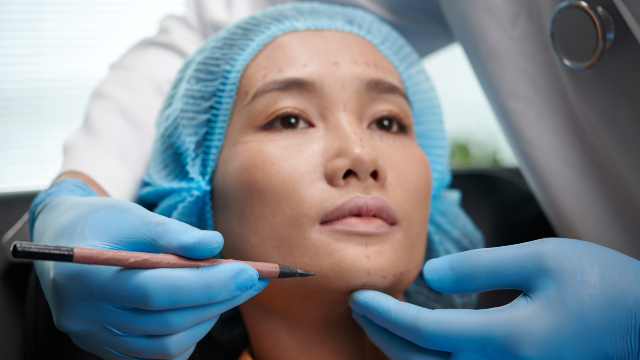
The idea behind chin augmentation is facial harmony, not chasing a single "ideal" shape. Surgeons assess the chin in relation to the rest of the face — the projection of the nose, the position of the lips, the length and angle of the jaw, and the transition into the neck. A chin that is under-projected (set back relative to these landmarks) can throw the profile out of balance; bringing it forward slightly can make the whole lower face look more proportionate.
This is a recognized concept in aesthetic surgery. The American Society of Plastic Surgeons notes that chin procedures are frequently suggested to improve the balance between the chin, jaw, cheek, and forehead, and that a chin adjustment is sometimes recommended alongside a nose procedure because the size of the chin can magnify or minimize how large the nose appears. In other words, chin augmentation is often less about the chin in isolation and more about how the chin lets the rest of the face settle into proportion.
Because "harmony" is individual, there is no universal target. What looks balanced on one face may look overdone on another, depending on bone structure, soft-tissue thickness, sex-related differences in jaw shape, and personal preference. A careful consultation is where a realistic, individualized plan is discussed — including the honest possibility that a person's chin is already well proportioned and needs nothing at all.
Option One: The Chin Implant
A chin implant is a solid, shaped device — commonly made of silicone — that is placed directly over the chin bone to add projection and definition. It is a surgical procedure. According to StatPearls, chin augmentation with an alloplastic (synthetic) implant is a well-established technique for correcting a horizontally deficient chin, and silicone is among the most widely used implant materials because it is well tolerated and can be adjusted or removed if needed.
In broad terms, the surgeon makes a small incision — typically either inside the mouth (in the crease below the lower lip, leaving no external scar) or under the chin — creates a precise pocket on the surface of the bone, positions the implant, and closes the incision with sutures. The procedure is usually performed as day surgery under local anesthesia with sedation or under general anesthesia, depending on the plan and individual factors. Mild swelling in the first days is normal, and many people are back to routine activities within about a week, though this varies.
The appeal of an implant is that it provides a stable, structural change to projection that does not need to be topped up over time. It is worth being precise, though: an implant is a long-term device, but it is not a "lifetime" guarantee and is not "permanent" in the sense of being maintenance-free forever. Implants can, in some cases, need adjustment, repositioning, or removal years later, and the surrounding tissue continues to age. It is also a distinct alternative to a bony genioplasty, in which the chin bone itself is cut and moved — a more involved operation that a surgeon may raise for certain anatomies. Which approach suits you, if any, is an examination-based decision.
Honest Risks of a Chin Implant
Any implant procedure carries real risks, and informed consent means understanding them before deciding. General surgical risks include bleeding, infection, swelling, bruising, and altered sensation of the lower lip and chin, which is usually temporary but can occasionally persist. Implant-specific risks deserve particular attention:
- Malposition or shifting: the implant can sit slightly off-center or move from its intended position, which may look asymmetrical and sometimes requires a revision to reposition it.
- Infection around the implant: because an implant is a foreign device, an infection may not settle with antibiotics alone and can, in some cases, mean the implant must be removed and replaced later.
- Extrusion: rarely, an implant can erode toward the surface or work its way toward an incision, which requires surgical management.
- Bone resorption: over time, some remodeling of the bone beneath a chin implant can occur; this is usually minor but is a recognized long-term consideration.
- Sensory changes and asymmetry: the mental nerve runs nearby, so numbness can occur; and because faces are never perfectly symmetrical to begin with, a flawless mirror-image result cannot be promised.
None of this means implants are unsafe — they are a standard, well-studied option — but no ethical surgeon promises a perfect, permanent, or risk-free outcome. Results vary between individuals.
Option Two: HA Filler for the Chin
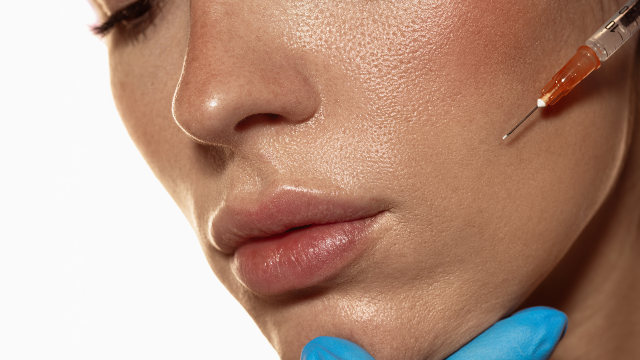
The non-surgical route is hyaluronic-acid (HA) filler, an injectable gel placed to add projection or refine the shape of the chin without an incision. Hyaluronic acid is a substance that occurs naturally in the body, and HA gels are used to add volume and contour; the FDA has approved certain dermal fillers for facial augmentation, which can include the chin area. Filler is quick, involves little to no downtime beyond possible short-lived swelling or bruising, and gives an immediate preview of added projection.
The defining feature of filler is that it is temporary and non-permanent. HA is gradually absorbed by the body, so the effect fades over months and needs to be repeated to be maintained — the exact duration depends on the material and the individual. A practical advantage is that HA filler is, to a meaningful degree, reversible: an enzyme called hyaluronidase can dissolve HA gel if the result is unsatisfactory or if a complication arises. This adjustability makes filler a reasonable way to "test" the idea of more chin projection before committing to surgery, or a suitable choice for someone who wants a subtle, non-surgical change.
Filler is not without risk. The FDA notes that dermal fillers can cause bruising, swelling, redness, tenderness, and lumps or nodules, and that the most serious risk — though uncommon — is unintentional injection into a blood vessel, which can cause tissue damage and, very rarely, more serious harm. This is why injections should be performed only by a qualified, experienced medical professional who understands facial anatomy. Filler also cannot replicate the firm, structural projection of an implant, so it is better suited to modest refinement than to large changes.
Implant vs Filler: Choosing Between Them
The honest framing of chin filler vs implant is that they are different tools, not better-or-worse versions of the same thing.
HA filler is non-surgical, immediate, adjustable, and reversible, with minimal downtime — but temporary, requiring repeat treatments, and limited in how much structural projection it can add. It suits people who want a subtle change, who are undecided, or who prefer to avoid surgery.
A silicone implant is a single surgical procedure that provides a more defined, structural, and long-lasting change without ongoing top-ups — but it is surgery, with the risks of infection, malposition, and extrusion, and it is a long-term device rather than a permanent, maintenance-free one. It suits people seeking a more substantial or durable change and who accept a real operation and recovery.
Neither is "best" in the abstract. The right choice depends on how much projection you want, whether you prefer a reversible trial or a lasting result, your anatomy, and how much intervention and downtime you are willing to accept. Cost is not addressed here; the clinical fit is what a consultation determines.
Chin Augmentation Recovery
Chin augmentation recovery differs markedly between the two options, and the following is a general orientation rather than a fixed schedule.
After filler, most people have little to no true downtime. Some swelling, tenderness, or minor bruising at the injection sites can occur and typically settles within days. Strenuous activity, heat, and pressure on the area are usually best avoided briefly, per your provider's guidance.
After an implant, expect swelling and some bruising in the first several days, along with tightness and possibly altered sensation of the lower lip and chin. A soft diet and careful oral hygiene are usually advised when the incision is inside the mouth, and sutures are managed on your surgeon's schedule. Many people return to lighter routines within about a week, while avoiding strenuous activity for a period the surgeon defines. Residual swelling can take several weeks to a few months to fully resolve, so the final shape settles gradually. Because Goodline sets recovery and travel windows individually, international patients should confirm their own timeline and plan a realistic stay that allows for early follow-up before flying home.
Chin Surgery Candidacy
Chin surgery candidacy is determined by examination, not by a photograph or a wish for a particular celebrity look. A surgeon evaluates the position and projection of the chin in relation to the nose, lips, jaw, and neck; the underlying bone; soft-tissue thickness; dental occlusion (how the teeth meet); skin quality; and general health. This assessment guides whether augmentation is appropriate at all, and if so, whether an implant, filler, or a bony genioplasty best fits the anatomy.
Good candidates are generally in good health, understand that results vary and cannot be guaranteed, and have realistic expectations about what a chin change can and cannot achieve. Some concerns that look like a "small chin" are actually related to jaw position, bite, or neck fullness, and are better addressed differently — which is exactly why an honest, individualized consultation matters more than any preset plan.
Planning Your Consultation
Goodline Plastic Surgery is located in the Apgujeong area of Gangnam, Seoul, near Apgujeong Station Exit 4, and has operated since 2001. It is a Registered Medical Institution for Attracting Foreign Patients certified by the Korean Ministry of Health and Welfare (MOHW) and offers basic English-language support, with online consultation available through its contact page. Reviewing surgeon Dr. Choi Deokho is a board-certified plastic surgeon (성형외과전문의) under the Korean plastic-surgery specialty certification, with a documented focus that includes facial contouring.
If you are considering chin augmentation in Korea, the most useful next step is a consultation where your facial proportions, anatomy, and goals can be assessed and the suitable option — implant, filler, or neither — discussed candidly. You can begin with an online consultation and share your history and photographs first. Learn more at the Goodline Plastic Surgery website or get in touch through the contact page.
Frequently Asked Questions
Is a chin implant permanent?
A silicone chin implant is a long-term device, but it is not a lifetime guarantee and should not be described as permanent or maintenance-free. It can, in some cases, need repositioning, adjustment, or removal years later, and the face continues to age around it. Your surgeon can explain what longevity is realistic for your situation.
How is chin filler different from a chin implant?
Filler is a non-surgical injectable that adds projection temporarily and is largely reversible with an enzyme called hyaluronidase, but it fades over months and needs repeating. An implant is a single surgical procedure that provides a more structural, longer-lasting change without top-ups, at the cost of real surgery and its risks. They are different tools suited to different goals.
What are the main risks of a chin implant?
Risks include bleeding, infection around the implant, swelling, temporary or occasionally lasting numbness of the lower lip and chin, implant malposition or shifting, extrusion, some bone remodeling over time, and asymmetry. Serious complications are uncommon but not zero. A candid discussion of these risks is part of deciding whether surgery is right for you.
Can chin filler be dissolved if I do not like it?
Hyaluronic-acid fillers can generally be reduced or dissolved using hyaluronidase, which is one reason HA filler is a reasonable way to trial more chin projection before considering surgery. That said, dissolving is a medical procedure with its own considerations and is best handled by a qualified provider. Not every complication is fully or instantly reversible.
How long is recovery after a chin implant?
Recovery varies by individual. Swelling and bruising are usually most noticeable in the first several days, many people resume lighter routines within about a week, and residual swelling can take several weeks to a few months to fully settle. Because Goodline sets recovery and travel windows individually, confirm your own timeline at consultation.
Do I need chin augmentation if I am getting a nose procedure?
Not necessarily, but the two are related. Because the chin and nose together shape the profile, a surgeon may raise chin balance during a rhinoplasty consultation, since the chin can affect how large the nose appears. Whether a chin change would help you is decided by examination, not automatically.
Is chin augmentation decided from photos I send online?
Online consultation and photographs are a helpful starting point, but they cannot replace an in-person examination. Bone structure, soft-tissue thickness, bite, and sensation all need to be assessed directly before any option is recommended. Final candidacy and the specific plan are confirmed in person.
The Bottom Line
- Chin augmentation is about facial harmony — how the chin balances the nose, lips, jaw, and neck — rather than a single ideal shape.
- A silicone implant gives a structural, long-lasting change through surgery; it is a long-term device, not a permanent, risk-free one.
- HA filler adds projection temporarily, involves little downtime, and is largely reversible with hyaluronidase, but it fades and needs repeating.
- Honest risks include infection, malposition, extrusion, and numbness for implants, and swelling, nodules, and rare vascular events for filler; results vary.
- Only an in-person examination can determine which option — implant, filler, or neither — is appropriate for you.
This article is for general education and is not a self-diagnosis tool. It does not replace a personal consultation with a qualified plastic surgeon, and it does not establish a doctor-patient relationship. Decisions about chin augmentation, candidacy, and technique should be made with a licensed surgeon after an in-person examination. Individual results vary.
References
- Facial Chin Augmentation (Chin Implants) — StatPearls, NCBI Bookshelf
- Facial Implants — StatPearls, NCBI Bookshelf
- Chin Surgery (Genioplasty/Mentoplasty) — American Society of Plastic Surgeons
- Dermal Fillers (Soft Tissue Fillers) — U.S. Food and Drug Administration
- Hyaluronic Acid — StatPearls, NCBI Bookshelf
More Articles
Continue reading our clinical guides.

Revision Rhinoplasty in Seoul: What US Patients Should Know
Revision rhinoplasty in Seoul for US patients: why secondary nose surgery is harder, what recovery looks like, honest expectations, and Goodline's plan.
Learn More
Rejuran vs RE20 vs Juvelook Volume: Skin Boosters Compared
Three injectables that look alike on a clinic menu and solve three unrelated problems. Hydration, repair and volume differ in timeline and in results.
Learn More

Primary vs Revision Rhinoplasty: The Differences That Matter
A second nose operation is not the first one repeated. Scar tissue, longer operating time and a result that takes a year change what you should expect.
Learn More