Natural-Looking Face & Neck Lift Surgery and Personalized Anti-Aging Care in Apgujeong, Gangnam, Seoul
4.1 ★ Google · Board-Certified Plastic Surgeon
en-US

Medical Guide
Y-Zone Liposuction & Lift vs Standard Abdominal Liposuction
One removes fat. The other removes fat and addresses loose skin, which is the part liposuction alone cannot do. The candidate descriptions say so plainly.
Schedule a Consultation
Y-Zone Liposuction & Lift vs Standard Abdominal Liposuction
Medically reviewed by Dr. Choi Deokho, Representative Director, Goodline Plastic Surgery
The name of one of these two contains the answer, and almost nobody reads it that way. Y-Zone Liposuction and Lift is two words longer than abdominal liposuction, and the extra word is the whole comparison.
Liposuction removes fat. It does not tighten the covering that was holding the fat. When the covering is the complaint, removing what was underneath it can make matters look worse rather than better, and that is the situation the second procedure exists for.

What the candidate descriptions actually say
Goodline Plastic Surgery describes candidates for abdominal liposuction as adults who are generally healthy, close to their stable or desired weight, and who have localized excess abdominal fat that has not responded well to diet and exercise. It adds a condition that deserves its own sentence: good candidates should also have realistic expectations about body contouring rather than treating liposuction as a weight-loss procedure.
It describes candidates for Y-Zone Liposuction and Lift as adults with localized fat and/or loose skin in the Y-zone who are in suitable health, have a stable weight and have realistic expectations.
Four words carry the difference: and/or loose skin. That phrase does not appear in the abdominal description, and no amount of fat removal produces skin tightening. Where it is present, it is present, and it is the finding that decides which procedure answers the complaint.
If you cannot tell which applies to you, that is ordinary. It is also the reason both descriptions end at "a consultation is needed" rather than at a rule.
The warning about weight
The abdominal description contains the only explicit disclaimer in either: liposuction is not a weight-loss procedure.
This sounds like boilerplate and is not. It explains why "close to their stable or desired weight" appears in the candidate description, and it explains why significant weight instability appears among reasons to postpone, alongside uncontrolled medical conditions, significant bleeding or clotting problems, active infections, conditions that could make anesthesia or surgery unsafe, and pregnancy.
The Y-Zone list reaches the same place by a different route, naming unstable weight among reasons to postpone along with uncontrolled medical conditions, active infection, significant healing problems, and unrealistic expectations.
Both procedures remove fat from a place. Neither changes what the body does with the fat it still has, which is why a result achieved before weight has settled is a result built on a moving base. MedlinePlus has a plain overview of weight control that is worth reading as background rather than as instruction.
The two descriptions are incomplete in opposite places
This is worth saying openly, because it changes how the numbers below should be read.
The clinic's material gives a planning stay for abdominal liposuction and does not give one for the Y-Zone procedure. It gives a recovery timeline and a final-result horizon for the Y-Zone procedure and does not give them for abdominal liposuction. Neither description is a full account, and the gaps are in different places.
The honest way to use this is to take each figure as belonging to the procedure it was given for, and to ask about the missing one rather than assuming it transfers. Below, each number is attributed.
Stay, abdominal liposuction: the clinic describes approximately five to seven days as a practical planning estimate for international patients, so that the initial postoperative check and recovery assessment can be completed before returning home, with the exact duration depending on the procedure and the patient's recovery.
Recovery timeline, Y-Zone: swelling and bruising are described as usually most noticeable during the first one to two weeks and gradually improving, with more complete recovery and tissue settling taking several weeks.
Final result, Y-Zone: the clinic describes the final contour as generally assessed after several months, once swelling has largely resolved and tissues have settled.
Operating time, abdominal liposuction: commonly about one to three hours, depending on the amount of fat being removed, the treatment area, the technique, and whether other procedures are performed at the same time.
What recovery feels like, which is similar
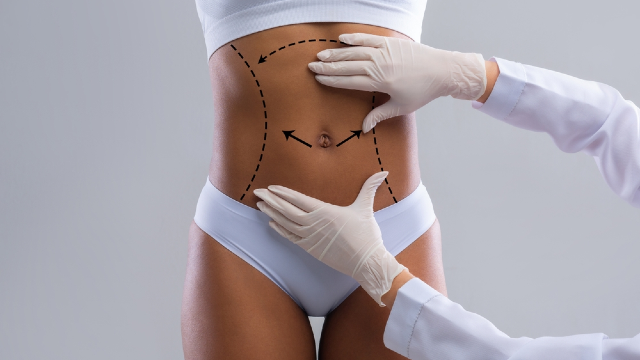
The side-effect lists overlap almost entirely, and the overlap is informative.
For abdominal liposuction the clinic names swelling, bruising, soreness, tenderness, numbness or altered sensation, tightness, and temporary irregularities in the treated area, with small amounts of fluid drainage possible during early recovery. For the Y-Zone procedure it names swelling, bruising, soreness, temporary numbness, tightness and fluid retention around the treated area.
Two of those deserve expectation-setting in advance.
Numbness. It appears on both lists as a common temporary effect, and on the Y-Zone risk list in a more durable form as persistent numbness. An area that feels like it belongs to somebody else for weeks is normal and is not often mentioned to people beforehand.
Irregularity. Temporary irregularities appear on the abdominal side-effect list, and contour irregularities appear on both risk lists. The distinction between the two is time: an uneven surface during the swelling period is expected, and an uneven surface after everything has settled is a result.
The American Academy of Dermatology's overview of liposuction is a useful second account of what the procedure does and does not do.
Risks: one item is on only one list
The lists are close. For abdominal liposuction the clinic names infection, bleeding, fluid accumulation, contour irregularities, asymmetry, changes in skin sensation, scarring, skin injury, blood clots, and complications related to anesthesia, noting that rare but serious complications can occur particularly with extensive procedures. For the Y-Zone procedure it names infection, bleeding, contour irregularities, asymmetry, scarring, persistent numbness, fluid accumulation and complications related to anesthesia or surgery.
Blood clots appear on the abdominal list and not the Y-Zone list. That is a real difference in what was written down rather than a claim that one procedure is free of the concern, and it is a reason to raise the subject directly if you have any history of clotting, are taking hormonal medication, or have a long flight ahead of you. MedlinePlus covers blood clots in general terms, and a long-haul flight after any operation on the trunk or limbs is a conversation to have with the surgeon rather than a thing to work out at the airport.
For the Y-Zone procedure the clinic describes how risk is reduced: careful assessment, treatment planning, sterile technique, appropriate fat removal and postoperative monitoring. The phrase appropriate fat removal is doing something specific there. Taking more is not taking better, and over-resection is one of the ways a contour irregularity becomes a result rather than a phase.
Anesthesia
Both are described the same way, and the description is conditional rather than fixed.
For abdominal liposuction the clinic says the method depends on the treatment extent and individual circumstances: local anesthesia with sedation may be appropriate for some procedures, while general anesthesia may be used for larger or combined ones, with the appropriate method determined during the preoperative assessment. For the Y-Zone procedure it says that depending on the extent of treatment, local anesthesia with sedation or general anesthesia may be used.
So the answer to "will I be asleep" is "it depends on how much is being done", for either. That is worth knowing before the day, because it changes fasting instructions, recovery arrangements and who needs to collect you.
Published results are collected in the before-and-after gallery, and the departments the clinic runs are described under about the clinic.
Preparing
The two preparation lists are nearly the same and both are more demanding than people expect.
The clinic asks, before abdominal liposuction, for a complete medical history and disclosure of all medications, supplements, allergies and previous procedures; adherence to instructions about eating, drinking, medications, smoking and alcohol; transportation arranged afterwards; and suitable loose clothing and postoperative supplies prepared in advance. It asks that smoking and alcohol be avoided beforehand, and that aspirin, blood-thinning medicines and supplements that may increase bleeding not be taken unless specifically approved by the medical team — while saying clearly not to make significant changes to prescribed medication without medical advice.
For the Y-Zone procedure it asks for medical history, medications, allergies and previous procedures, and instructions followed regarding eating, drinking, medications, smoking and postoperative support, with the same guidance on substances that may increase bleeding or bruising.
The item travelers forget is the last one on the abdominal list: loose clothing and postoperative supplies. Buying those in an unfamiliar city, swollen and sore, on the day you need them, is an avoidable errand.
Frequently Asked Questions
What is the actual difference between the two?
One addresses fat; the other is described for localized fat and/or loose skin. Liposuction does not tighten skin, so where loose skin is part of the complaint, a procedure that includes a lift is addressing something the other cannot.
Will liposuction help me lose weight?
The clinic says directly that good candidates should have realistic expectations about body contouring rather than treating liposuction as a weight-loss procedure, and describes candidates as being close to a stable or desired weight already.
How long will I need to be in Korea?
For abdominal liposuction the clinic gives approximately five to seven days as a planning estimate so the initial check and recovery assessment can be completed. It does not state a figure for the Y-Zone procedure, which is a question to put to the clinic rather than an assumption to carry across.
When is the result final?
For the Y-Zone procedure the clinic describes the final contour as generally assessed after several months, once swelling has largely resolved and tissues have settled. For abdominal liposuction it describes more noticeable contour improvement developing over the weeks after swelling begins to decrease.
Is the numbness permanent?
Temporary numbness or altered sensation appears among common effects for both. Persistent numbness appears on the Y-Zone risk list, which means it is a recognized possibility rather than the expected course.
Will I be asleep?
It depends on how much is being done. Both descriptions allow for local anesthesia with sedation or general anesthesia, decided during the preoperative assessment according to the extent of treatment.
What should I avoid beforehand?
Smoking and alcohol, and aspirin, blood-thinning medicines or supplements that may increase bleeding unless your medical team has specifically approved them. Do not stop prescribed medication on your own; the clinic says so explicitly.
Why does weight stability matter so much?
Because both candidate descriptions require it and both postponement lists name instability. A contour created while weight is still moving is measured against a body that has not finished changing.
The Bottom Line
- The difference is in the candidate descriptions: abdominal liposuction addresses localized excess fat, while the Y-Zone procedure is described for localized fat and/or loose skin — and liposuction does not tighten skin.
- The clinic states plainly that liposuction is not a weight-loss procedure, and both procedures require a stable weight, with instability named among reasons to postpone.
- The two descriptions are incomplete in opposite places: a planning stay of approximately five to seven days is given for abdominal liposuction, and a recovery timeline and several-month final-result horizon are given for the Y-Zone procedure.
- Side effects largely overlap, with numbness and temporary contour irregularity the two worth expecting in advance; blood clots appear on the abdominal risk list specifically.
- Anesthesia is conditional for both — local with sedation or general, decided by the extent of treatment at the preoperative assessment.
This article is for general informational purposes and does not constitute individualized medical advice. It is not a self-diagnosis tool. Nothing here can establish whether your concern is fat, loose skin, or both, or whether either procedure suits you. Only a qualified plastic surgeon who has examined you can determine that, and increasing pain, fever, spreading redness, calf swelling or breathing difficulty after body contouring surgery should be treated as urgent where you are.
References
- American Academy of Dermatology — Liposuction
- American Academy of Dermatology — Non-Invasive Fat Reduction: What to Expect
- US Food and Drug Administration — Non-Invasive Body Contouring Technologies
- MedlinePlus — Weight Control
- MedlinePlus — Blood Clots
- MedlinePlus — Surgery
- MedlinePlus — After Surgery
- MedlinePlus — Anesthesia
- MedlinePlus — Edema
More Articles
Continue reading our clinical guides.

Revision Rhinoplasty in Seoul: What US Patients Should Know
Revision rhinoplasty in Seoul for US patients: why secondary nose surgery is harder, what recovery looks like, honest expectations, and Goodline's plan.
Learn More

Rejuran vs RE20 vs Juvelook Volume: Skin Boosters Compared
Three injectables that look alike on a clinic menu and solve three unrelated problems. Hydration, repair and volume differ in timeline and in results.
Learn More

Primary vs Revision Rhinoplasty: The Differences That Matter
A second nose operation is not the first one repeated. Scar tissue, longer operating time and a result that takes a year change what you should expect.
Learn More